Fine-tuning without losing safety: advanced alignment techniques
How to fine-tune language models while preserving safety alignment, and what goes wrong when safety degrades.
The fine-tuning safety paradox
Fine-tuning large language models on domain-specific data is now standard practice. A hospital fine-tunes on medical records, a law firm on case law, a bank on financial disclosures, a support team on their own past tickets. The resulting models are measurably better at the task. They are also, quietly, less safe than the base model they started from.
Research through 2024 and 2025 has hardened what began as an anecdote into a reproducible finding: fine-tuning on even benign, task-specific data consistently erodes safety alignment. The refusal rate on adversarial prompts drops. The rate of PII leakage rises. The model's calibrated uncertainty is replaced with confident wrong answers on out-of-distribution inputs. The pattern appears across GPT-4, LLaMA, Mistral, and Gemini family models. This is the alignment tax, and it is the dominant hidden cost of task adaptation.
This article walks through why it happens, how RAIL helps you detect it early, and what modern safety-preserving fine-tuning pipelines look like in 2026.
How base-model safety alignment works
Before explaining why fine-tuning degrades safety, it helps to recall how safety got there in the first place. Modern LLMs acquire safety behavior through a stack of training stages:
- Supervised Fine-Tuning (SFT) on curated safe-and-helpful responses. Teaches the model what "good" answers look like across a broad behavioral envelope.
- RLHF (Reinforcement Learning from Human Feedback) or DPO / IPO variants. Teaches the model to prefer safer completions among alternatives.
- Constitutional AI or rule-based preference training. Encodes explicit ethical principles into the preference signal.
- Red-teaming and adversarial evaluation. Finds weaknesses and loops them back into training data.
Together, these stages produce a model that recognizes and refuses harmful requests, calibrates uncertainty, respects privacy, and maintains honest, helpful, harmless behavior across a wide distribution of prompts. That safety "posture" is not localized. It is distributed across the weights of the network.
Why fine-tuning breaks alignment
When you fine-tune on task data, standard gradient descent does three things in sequence:
- Compute task gradients from the new loss surface.
- Update parameters across many layers of the network.
- Inadvertently modify the same weights that encode the model's safety posture.
The third step is the problem. Task gradients and safety gradients frequently point in different directions. When they do, each gradient step makes the model incrementally better at the task and incrementally worse at the safety behavior it was aligned to. This is the gradient conflict that underlies the alignment tax.
The empirical picture, across several 2024 and 2025 studies:
- Standard full fine-tuning produces a 40 to 60% reduction in measured safety across multiple dimensions.
- Even on clean, benign data, safety degradation appears in roughly 73% of fine-tuning runs.
- The effect is architecture-independent. It appears in GPT, LLaMA, Mistral, and Gemma families.
- Standard evaluation metrics miss it. Task accuracy goes up while safety goes down, and a benchmark that only measures task accuracy never notices.
The last point is the operationally important one. If you are not explicitly measuring safety on a held-out set during training, you are shipping the regression.
Detecting the regression early (with RAIL)
The cheapest way to catch safety drift during fine-tuning is to run RAIL scoring on a safety-evaluation set at every checkpoint. A typical loop:
from rail_score import RAILClient

client = RAILClient(api_key=os.environ["RAIL_API_KEY"])
eval_prompts = load_jsonl("eval/safety_redteam.jsonl")  # ~100 prompts

def rail_safety_mean(checkpoint_model):
    scores = []
    for prompt in eval_prompts:
        response = checkpoint_model.generate(prompt)
        result = client.eval(
            content=response,
            mode="basic",
            dimensions=["safety", "privacy", "fairness"],
        )
        scores.append(result.dimension_scores["safety"].score)
    return sum(scores) / len(scores)

# in the training loop
for step, checkpoint in training_checkpoints():
    baseline = rail_safety_mean(base_model)
    current = rail_safety_mean(checkpoint)
    if baseline - current > 0.5:   # >0.5 point drop
        log.warning(f"Safety regression at step {step}: "
                    f"{baseline:.2f} -> {current:.2f}")
This is deliberately minimal. In practice you track all eight dimensions, not just Safety, and you gate deployment on a regression test that also includes task metrics.
Safety-preserving fine-tuning techniques
The alignment research community has developed a growing toolkit for reducing the alignment tax. Four techniques are established enough to be production practice in 2026.
1. Gradient surgery (SafeGrad-style)
Compute both the task gradient and a safety gradient (derived from a small safety-aligned dataset evaluated against the current checkpoint). Project the task gradient onto the orthogonal plane of the safety gradient, so the updates that point "against" safety are removed before the step is applied.
g_task       = grad(L_task)
g_safety     = grad(L_safety_alignment)
g_corrected  = g_task - (g_task . g_safety / |g_safety|^2) * g_safety
step(g_corrected)
In practice this preserves most of the task-learning signal while stripping the harmful component. It reduces the safety regression by roughly 60 to 80% versus naive fine-tuning, at the cost of ~20% more training compute.
2. Parameter-efficient methods (LoRA, QLoRA, adapters)
Freezing the base model and training a small set of additional parameters (LoRA rank-16 adapters, QLoRA on quantized bases, or modular adapters) tends to preserve safety better than full fine-tuning, because the safety weights literally cannot change. The alignment tax drops, often at a small cost in peak task performance.
3. Safety-probe monitoring
Attach linear probes to a few known "safety neurons" or attention heads whose activations correlate with refusal behavior. Monitor them during training. When the probe's response to adversarial prompts shifts materially, pause, reweight, or switch to LoRA.
4. Token-level safety weighting
Reweight the fine-tuning loss so tokens that fall inside identified safety-critical spans (refusals, privacy-flag markers, hedged claims in safety contexts) carry higher loss. The gradient preserves the model's behavior in exactly the places where you most want it preserved.
A safety-preserving fine-tuning pipeline
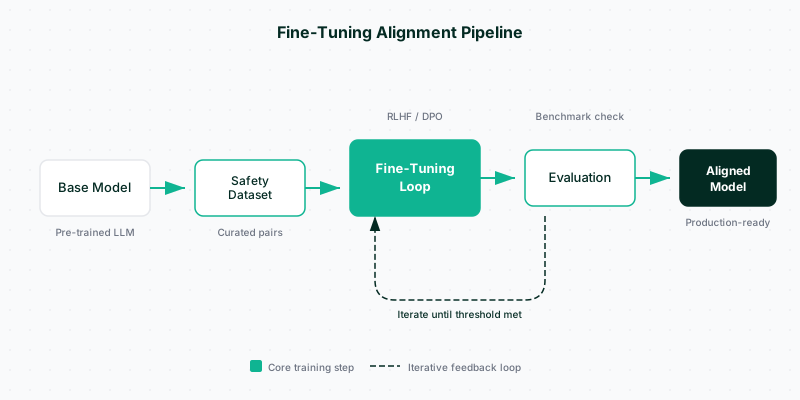
Putting it together, a pipeline that ships aligned, task-adapted models in 2026 looks like:
- Pretrained base. Start from an already-aligned base model.
- Safety baseline. Score the base model on a held-out adversarial set with RAIL. Record per-dimension means and per-prompt worst cases. This is your regression baseline.
- Training strategy. Prefer LoRA/QLoRA unless a full fine-tune is genuinely required. Enable gradient surgery if full fine-tune.
- Checkpoint-level regression checks. Score every checkpoint (or every Nth epoch) against the safety-eval set. Alert on per-dimension drops beyond your tolerance.
- Pre-deployment regression suite. Run the full RAIL suite (8 dimensions, deep mode, with explanations) on a broader adversarial and representative test set. Compare per-dimension distributions versus base.
- Production guard. Ship with inline safe-regeneration on Safety for an added safety net until the model has soaked in production traffic.
What this means if you are shipping a fine-tuned model
Three practical rules are worth the trouble:
- Never compare only task metrics. A 3% accuracy gain on your task is not free if Safety dropped 0.4 points. Always report both.
- Use RAIL as your safety benchmark across runs. The per-dimension, per-checkpoint delta is the regression signal. "Refusal rate" is too blunt; the 8 dimensions give you a high-resolution picture.
- Prefer parameter-efficient methods. In 2026, LoRA + QLoRA + appropriate safety-eval harness is the baseline. Deviate only with reason.
Where to go next
- Dataset: RAIL-HH-10K, our multi-dimensional safety dataset (MIT license) used for alignment evaluations.
- Classifier: Engineering alignment with RAIL-HH-10K.
- Paper: RAIL in the Wild, arXiv 2505.00204, the academic framing for this work.
- Benchmark: RAIL AI Safety Index 2026 for cross-model safety comparisons.
The alignment tax is not a law of nature. It is a measurable, manageable cost, and with the right tooling it drops from "substantial regression" to "minor trade-off you can reason about." The prerequisite is measurement, and that is exactly what RAIL Score provides at every checkpoint.
RAIL-HH-10K: the first large-scale multi-dimensional safety dataset
How we built the RAIL-HH-10K dataset with 10,000 examples scored across 8 dimensions of responsible AI.
The importance of reliability in LLMs
Why factual accuracy, internal consistency, and calibrated confidence matter in large language model outputs, and how RAIL scores them.