
Safe Regeneration: how RAIL automatically fixes unsafe AI outputs
Why blocking unsafe AI outputs is not enough. How RAIL's Safe Regeneration moves beyond binary flag-and-block to iteratively detect, fix, and verify AI responses -- preserving utility while enforcing safety.
The AI safety industry has a binary problem. The dominant paradigm across every major cloud provider works the same way: classify input or output, block if unsafe, show a canned refusal message, end of interaction. AWS Bedrock "blocks up to 88% of harmful content" -- which means 12% passes through, and 100% of blocked queries return nothing useful. Global business losses from AI hallucinations alone reached $67.4 billion in 2024. The industry needs a better approach.
Key Takeaways
- 233 documented AI incidents in 2024, a 56.4% increase over 2023. Hallucinations constitute 38% of all incidents.
- $67.4 billion in estimated global business losses from AI hallucinations in 2024.
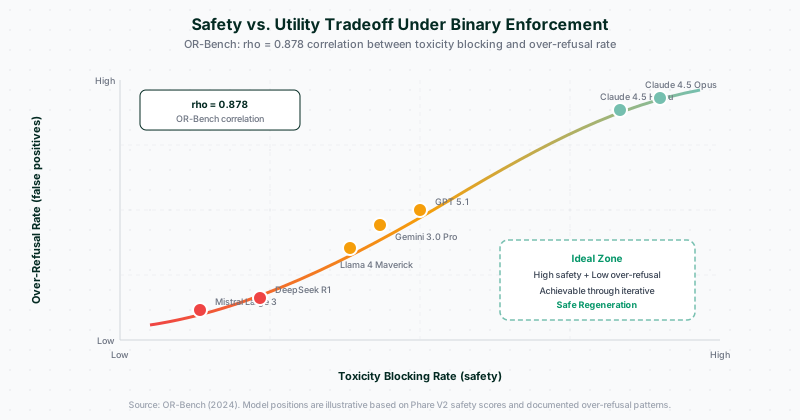
- OR-Bench found a rho = 0.878 correlation between toxicity blocking and over-refusal -- safety and over-refusal are deeply coupled under binary enforcement.
- Most guardrail systems operate on binary block/allow. Only a few systems go beyond simple blocking.
- RAIL's Safe Regeneration takes a fundamentally different approach: detect, fix, and verify rather than block and refuse.
- The paradigm shift from "flag and block" to iterative remediation preserves both safety and utility.
The scale of the problem
AI incidents are accelerating
Stanford's AI Index 2025 documented 233 AI safety incidents in 2024 -- a record high and a 56.4% increase from 149 in 2023. Hallucinations constitute 38% of documented incidents, making them the leading cause. The human cost is measurable: knowledge workers spend 4.3 hours per week verifying AI output (Microsoft 2025), and per-employee hallucination mitigation costs average $14,200/year.
Perhaps most concerning: 47% of enterprise users admitted to making major decisions based on hallucinated content (Deloitte 2024). The combination of high hallucination rates and high user trust creates a systemic risk that binary blocking cannot address.
Best-in-class hallucination rates
Even the best models hallucinate. On summarization tasks, Gemini-2.0-Flash achieves a 0.7% hallucination rate (Vectara HHEM, April 2025). But domain-specific rates remain high: 69--88% on legal queries (Stanford RegLab), 33--48% on personal fact queries for reasoning models (o3 and o4-mini on PersonQA). RAG reduces hallucination rates by up to 71% but does not eliminate them.
The content moderation market
The global content moderation market stands at $11.6--12.5 billion in 2025, projected to reach $26 billion by 2031 (14.4% CAGR). The AI-specific content moderation subset is estimated at $1.5 billion in 2024, growing to $6.8 billion by 2033 (18.6% CAGR). Enterprise spending on AI safety is ramping: organizations with AI-specific security controls reduced breach costs by $2.1 million on average (IBM 2025).
The guardrail landscape: most systems block, few fix
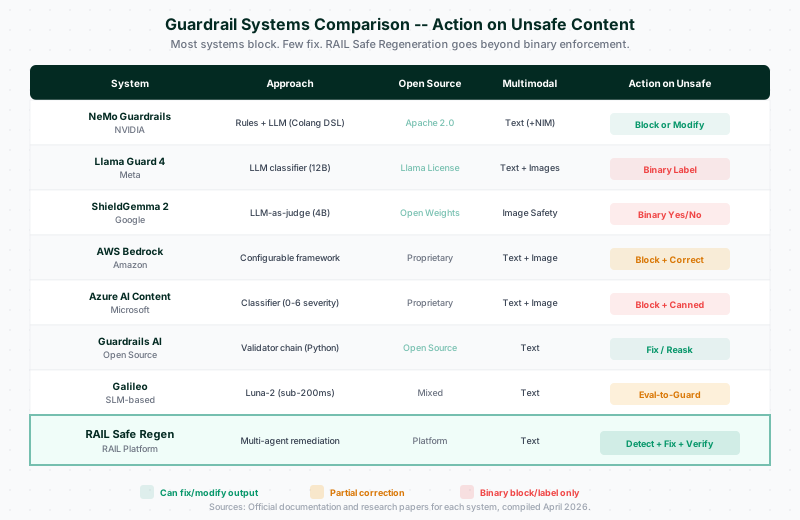
The current landscape of guardrail systems reveals a critical gap. Most operate on a binary model:
| System | Action on Unsafe Content |
|---|---|
| NeMo Guardrails | Block or modify/rephrase |
| Llama Guard 4 | Binary safe/unsafe label |
| ShieldGemma 2 | Binary Yes/No |
| AWS Bedrock Guardrails | Block + custom message (Automated Reasoning can correct) |
| Azure AI Content Safety | Block + canned message |
| Guardrails AI | Fix, reask, filter, or exception |
| Galileo | Eval-to-guardrail lifecycle |
| Lakera Guard | Block |
Only three systems go beyond simple blocking: NeMo Guardrails (output modification), Guardrails AI (fix/reask actions), and AWS Automated Reasoning (formal logic-based correction). The rest -- including the major cloud provider offerings -- enforce a binary block/allow model that treats safety as a gate rather than a process.
Five fundamental problems with "flag and block"
1. False positives destroy utility
OR-Bench found a rho = 0.878 correlation between a model's ability to block toxic prompts and its over-refusal rate. Safety and over-refusal are deeply coupled under binary enforcement. Claude models demonstrate the highest safety but also the highest over-refusal rates. The FalseReject benchmark (May 2025) confirmed that safety tuning induces persistent over-refusal. Documented cases include Azure flagging "door-knocking" and "Metro Tunnel" as violent content.
2. No information recovery
When a guardrail blocks a response, the user gets nothing useful -- even if 95% of the response was safe and only one sentence was problematic. The entire response is discarded, and the user receives a generic refusal message. This is the equivalent of deleting an entire document because of one problematic paragraph.
3. User frustration drives unsafe behavior
Repeated blocking pushes users toward unguarded alternatives. This "model shopping" behavior means that stricter guardrails can paradoxically reduce overall safety by driving users to less protected systems.
4. Overly broad enforcement
Binary systems block the entire response even if only one sentence is problematic. There is no mechanism to identify the specific unsafe element, remove or fix it, and preserve the rest of the response.
5. Zero-sum safety-utility tradeoff
Under binary enforcement, more safety always means less utility. Every increase in the blocking threshold increases false positives. The target enterprise false-positive rate should be <2% (Obsidian Security), but achieving this while maintaining high safety rates is structurally difficult under a binary model.
Emerging alternatives: from blocking to fixing
Several approaches are emerging that move beyond binary enforcement:
Guardrails AI: fix/reask actions
Guardrails AI's validator chain can take four actions on failure: fix (attempt to correct the output), reask (retry with a modified prompt), filter (remove the offending element), or raise an exception. This is the most mature open-source implementation of correction-first guardrails.
NeMo Guardrails: output modification
NVIDIA's NeMo Guardrails can modify input to mask sensitive data or rephrase unsafe content rather than blocking outright. The Colang DSL provides fine-grained control over what happens when safety violations are detected.
AWS Automated Reasoning
AWS Bedrock's Automated Reasoning uses formal logic to verify, correct, and explain AI outputs. Amazon claims 99% accuracy for verified outputs. This represents the most sophisticated cloud-provider approach but is limited to AWS's ecosystem.
Rejection sampling
Generate multiple candidate outputs and present the safest one that still answers the query. This preserves utility at the cost of increased latency and compute.
Constitutional AI
Anthropic's training-time approach embeds self-critique and revision capabilities. Models learn to identify and fix their own problematic outputs during generation. This is effective but operates at training time rather than deployment time.
RAIL's Safe Regeneration: the correction-first paradigm
RAIL's Safe Regeneration takes a fundamentally different approach from binary enforcement. Instead of blocking unsafe outputs, it detects, fixes, and verifies them through an iterative multi-step process:
Step 1: Detection
The RAIL Score Evaluator analyzes the AI response across 8 safety dimensions (Fairness, Safety, Reliability, Transparency, Privacy, Accountability, Inclusivity, User Impact). Rather than a binary safe/unsafe classification, each dimension receives a granular score that identifies the specific safety concern.
Step 2: Targeted remediation
When a dimension scores below the configured threshold, Safe Regeneration does not block the entire response. Instead, it identifies the specific problematic elements and generates a corrected version that:
- Preserves the safe, useful portions of the original response
- Addresses the specific safety concern identified by the evaluator
- Maintains the original intent and information value
Step 3: Verification
The corrected response is re-evaluated against the same safety dimensions to confirm the fix was effective. If the corrected version still fails, the process iterates with refined remediation guidance. Only after verification does the response reach the user.
Why this matters
This approach breaks the zero-sum safety-utility tradeoff. Instead of choosing between blocking (safe but useless) and passing through (useful but potentially unsafe), Safe Regeneration delivers responses that are both safe and useful.
The practical difference:
- Binary system: User asks about medication interactions. Response mentions a specific drug combination. Guardrail flags the entire response as potentially harmful medical advice. User receives: "I cannot provide medical information." Zero utility.
- Safe Regeneration: Same query. Evaluator identifies the specific sentence with unsupported dosage claims. Safe Regeneration preserves the general interaction information while replacing the problematic claim with a verified statement and a recommendation to consult a healthcare provider. High safety, high utility.
AI safety incident data: why correction matters
The 233 documented incidents in 2024 break down by category:
- Hallucination / Factual errors: 38%
- Bias and discrimination: 24%
- Privacy violations: 18%
- Harmful content generation: 14%
- Transparency failures: 6%
Binary blocking only addresses the 14% that involves harmful content generation. Hallucinations -- the largest category at 38% -- cannot be solved by blocking because the model believes it is producing correct, safe content. The response passes safety classifiers because it does not trigger toxicity or harm detectors. Only a system that evaluates factual accuracy and then corrects errors can address this category.
Similarly, bias (24%) often manifests as subtle patterns across otherwise legitimate responses. Blocking every response that contains any statistical bias would render the system unusable. Corrective regeneration can identify and mitigate the specific biased elements while preserving the useful information.
The cost equation
Organizations with AI-specific security controls reduced breach costs by $2.1 million on average (IBM 2025). AI compliance spending is projected to reach $1 billion by 2030 (Gartner via Credo AI). The guardrails market specifically was valued at $0.7 billion in 2024.
But the hidden cost of binary blocking is harder to measure: lost productivity from false positives, user abandonment from over-refusal, and the opportunity cost of responses that could have been useful with minor corrections. When knowledge workers spend 4.3 hours per week verifying AI output, and 47% of enterprise users make decisions based on hallucinated content, the cost of not having correction capabilities is significant.
Conclusion
The AI safety industry is at an inflection point. The binary block/allow model that dominated the first wave of guardrail development is structurally inadequate for the scale and complexity of enterprise AI deployment. It creates a zero-sum tradeoff between safety and utility, fails to address the largest categories of AI incidents (hallucinations and bias), and drives users toward unguarded alternatives through over-refusal.
RAIL's Safe Regeneration represents the next generation of this paradigm: systems that detect safety issues with dimensional granularity, fix them through targeted remediation, and verify the correction before delivery. The goal is not to choose between safe and useful -- it is to deliver both.
Integrating RAIL Score into your AI workflow
How to add RAIL Score evaluation at every stage of your AI pipeline: development, CI, production, and monitoring.
When algorithms deny care: bias in healthcare AI
How algorithmic bias in healthcare AI leads to unequal treatment and what organizations can do to detect and prevent it.