Enterprise AI governance: implementation guide for 2025
A step-by-step guide to implementing AI governance frameworks in enterprise organizations.
From strategy to execution -- building responsible AI programs that scale
Published: November 6, 2025
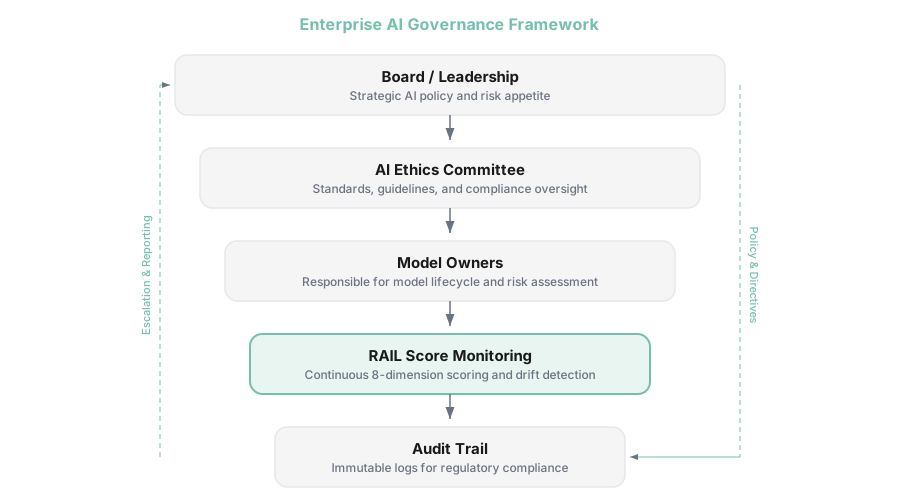
Enterprise AI Governance Framework: Four-Tier Structure
Tier 1: Policies and Standards
- Acceptable use policy
- Risk classification
- Data governance rules
Tier 2: Monitoring and Controls
- Continuous RAIL evaluation
- Automated alerts
- Audit logging
Tier 3: Model Review Process
- Pre-deployment testing
- Bias audits
- Red-teaming
Tier 4: Accountability and Oversight
- AI ethics board
- Executive sponsorship
- Incident response
The AI Governance Imperative
According to the IAPP's 2025 AI Governance Profession Report, "77% of organizations are actively developing AI governance programs," with nearly half ranking governance among their top strategic priorities.
The regulatory landscape has shifted dramatically. Organizations now face requirements from the EU AI Act, multiple state regulations, heightened legal exposure, and executive accountability demands. Robust governance frameworks are no longer optional -- they're essential.
The central challenge remains consistent: most enterprises lack clear implementation pathways.
This guide offers a structured, actionable approach to deploying AI governance at scale, informed by established frameworks, documented organizational implementations, and insights from leading practitioners.
Current State of AI Governance
By the Numbers
Investment trends:
- AI ethics spending increased from 2.9% of AI budgets (2022) to 4.6% (2024), with projections reaching 5.4% (2025)
- This represents billions in aggregate organizational investment
- Despite spending growth, formal governance structures remain absent in many organizations
Common challenges (IAPP survey):
- Fragmented ownership: 43% of organizations
- Unclear accountability: 39%
- Lack of technical expertise: 52%
- Difficulty measuring AI risks: 47%
- Cross-functional coordination barriers: 41%
The Governance Gap
Most organizations have established:
- Data governance programs
- IT security frameworks
- Compliance functions
However, effective AI governance requires:
- AI-specific risk frameworks
- Cross-functional coordination across Legal, IT, Business, and Ethics
- Technical AI expertise
- Continuous monitoring capabilities
- Ethical oversight mechanisms
Leading Governance Frameworks
1. NIST AI Risk Management Framework (AI RMF)
Overview: The most widely adopted AI governance framework, developed by the U.S. National Institute of Standards and Technology.
Why it matters: Practical, risk-based, and adaptable across industries
Four core functions:
GOVERN: Establish culture and structure
- Define roles and responsibilities
- Create policies and procedures
- Allocate resources
- Establish accountability
MAP: Understand context
- Identify AI systems and use cases
- Map AI lifecycle stages
- Understand stakeholders
- Document intended purposes
MEASURE: Assess and benchmark
- Evaluate AI system performance
- Assess trustworthiness characteristics
- Test for bias, safety, security
- Benchmark against standards
MANAGE: Prioritize and respond
- Prioritize risks
- Implement controls
- Document decisions
- Monitor ongoing performance
Strengths:
- Flexible and adaptable
- Sector-agnostic
- Focuses on outcomes rather than prescriptive requirements
- Free and publicly available
Best for: Organizations of all sizes, particularly those in regulated industries
2. Databricks AI Governance Framework (DAGF)
Overview: Comprehensive framework spanning 5 pillars and 43 key considerations
The 5 Pillars:
1. Risk Management
- Risk identification and classification
- Mitigation strategies
- Impact assessments
2. Legal and Regulatory Compliance
- GDPR and CCPA compliance
- Industry-specific regulations
- Contractual obligations
3. Ethical Standards and Principles
- Fairness and bias mitigation
- Transparency and explainability
- Privacy protection
- Human oversight
4. Data Management and Security
- Data governance
- Data quality and lineage
- Access controls
- Encryption and security
5. Operational Oversight
- Model monitoring
- Performance tracking
- Incident response
- Change management
Strengths:
- Comprehensive coverage
- Operationally focused
- Includes technical implementation guidance
Best for: Data-intensive organizations, tech companies, ML-heavy enterprises
3. ISO/IEC 42001 - AI Management System
Overview: International standard for AI management systems
Key requirements:
- Top management commitment
- Risk-based approach
- Documented AI management system
- Competence and awareness
- Operational planning and control
- Performance evaluation
- Continual improvement
Certification: Organizations can seek ISO 42001 certification for third-party validation
Strengths:
- Internationally recognized
- Certification provides credible validation
- Aligns with other ISO management standards
Best for: Global enterprises, organizations pursuing formal certification
Practical Implementation Roadmap
Phase 1: Foundation (Months 1-3)
Step 1: Secure Executive Sponsorship
Critical success factor: Senior executive ownership
Key insight: Organizations with C-suite AI governance leadership are "3x more likely to have mature programs" according to IAPP research.
Action items:
- Identify executive sponsor (typically Chief Risk Officer, Chief Technology Officer, or Chief AI Officer)
- Present business case emphasizing:
- Regulatory compliance (EU AI Act, state laws)
- Risk mitigation (bias, safety, security)
- Competitive advantage through trustworthy AI
- Operational efficiency via systematic AI management
- Secure budget allocation (typically 4-6% of AI spending)
Deliverable: Executive sponsor commitment and budget approval
Step 2: Establish Governance Structure
Option A: AI Ethics Board (smaller organizations)
- 5-8 members with cross-functional representation:
- Legal
- IT/Security
- Data Science
- Business units
- External ethics expert (optional)
- Monthly meetings
- Reports to C-suite
Option B: Multi-Tier Governance (larger enterprises)
-
AI Governance Committee (executive level)
- Strategic oversight
- Quarterly meetings
- Final decision authority on high-risk AI
-
AI Review Board (operational level)
- Evaluates AI systems
- Monthly meetings
- Recommends approvals or denials
-
Working Groups (technical level)
- Bias testing, security assessment, etc.
- Continuous operations
Deliverable: Governance charter, membership roster, meeting schedule
Step 3: Create AI Inventory
Fundamental principle: Organizations cannot govern systems they don't fully understand or document.
Key Takeaways
- Enterprise AI governance has transitioned from optional to essential due to regulatory pressure and organizational risk exposure
- Three leading frameworks -- NIST AI RMF, Databricks DAGF, and ISO/IEC 42001 -- offer distinct approaches suited to different organizational contexts
- Executive sponsorship and cross-functional structures are prerequisites for implementation success
- A phased approach beginning with foundational elements (governance structure, AI inventory) enables scaling toward mature oversight programs
The future of AI content moderation: smarter, safer, more responsible
How AI content moderation is evolving beyond keyword filters to multi-dimensional safety evaluation.
The carbon cost of intelligence: AI's environmental footprint
The environmental impact of training and running large AI models -- carbon emissions, water usage, and energy consumption.