
The future of AI content moderation: smarter, safer, more responsible
How AI content moderation is evolving beyond keyword filters to multi-dimensional safety evaluation.
Why effective content moderation demands AI that is transparent, accountable, and responsibly designed
Published: January 20, 2026
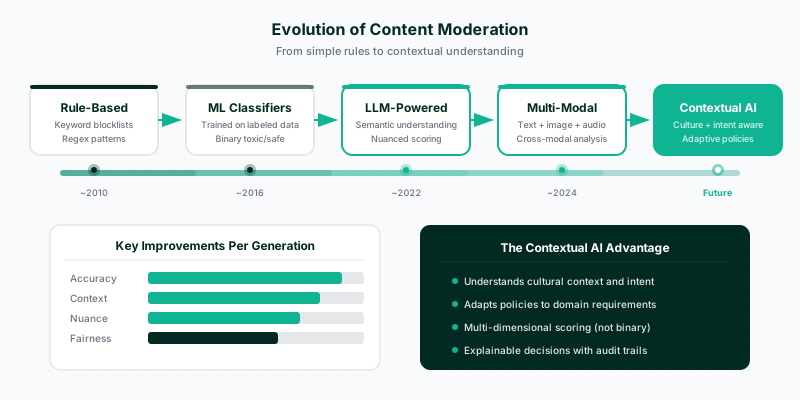
Content Moderation: Technology Evolution
2010-2016: Keyword filters
Static blocklists. High false positive rate. Easily bypassed.
2017-2020: ML classifiers
Binary safe / unsafe models. Better recall, poor context understanding.
2021-2023: Transformer-based scoring
Contextual classification. Handles nuance but single-dimensional.
2024-present: Multidimensional evaluation
8+ dimensions, per-response audit trail, actionable enforcement.
The Scale of the Challenge
More than 5.24 billion people worldwide currently use social media, according to Sprout Social's 2025 data. This statistic underscores how social platforms shape communication, information sharing, and opinion formation globally.
The internet originally envisioned as a unified space where "ideas could circulate freely; knowledge had no limits" has evolved differently than intended. Modern platforms struggle with spam bots, harassment, misinformation, and tensions between free expression and user safety.
Building safer digital communities requires "AI that is transparent, accountable, and responsibly designed."
AI's Role in Changing Content Moderation
AI-based content moderation transcends basic keyword detection. It learns from emerging trends, adapts to harmful behavior variations, and interprets tone and context rather than simply flagging offensive words.
Core Technologies:
-
Natural Language Processing (NLP): Enables context understanding beyond keywords. The comment "Go jump off a bridge" registers as harmful, while "That bungee jump off a bridge looked amazing!" remains unaffected.
-
Sentiment Analysis: Identifies hostility, sarcasm, and aggression, including subtle instances.
-
Image and Video Moderation: Detects harmful content involving violence, deepfake pornography, and misleading imagery intended to spread false information.
-
Adaptive Learning: Moves beyond static rules to recognize new slang, emerging dangers, and evolving online behavior.
However, bias and ethical concerns persist. Platforms must balance technological progress with human supervision to ensure fair, effective moderation establishing trust and safe online environments.
Why Content Moderation Matters for Safe Digital Spaces
Content moderation serves three critical functions:
-
Safety: Protects users from harmful and offensive material, creating secure communities.
-
Trust: Good moderation fosters user confidence. Well-managed content encourages engagement and participation benefiting both platforms and communities.
-
Compliance: Laws and regulations mandate proper content management. Non-compliance carries serious consequences, making moderation essential for legal compliance and industry standards maintenance.
The Challenge of AI Content Moderation
Online dialogues involve humor, sarcasm, and emotion that don't align with programming logic. AI struggles distinguishing between passionate discussion versus deliberate harassment, robust critique versus genuine threats, lighthearted remarks versus genuinely damaging statements.
Real-World Failures:
- Cancer support communities flagged for "violent language" when participants discuss "killing cancer"
- Gaming discussion boards removing threads about "battle strategies" due to warfare terminology misinterpretation
- Historical conversations about previous conflicts categorized as misinformation
Bias within AI mirrors the data used for training, presenting significant challenges. "Misjudged content, hidden bias, and lost context show why AI content moderation must be approached with care."
Human Moderators vs. Automated Solutions: Achieving the Optimal Balance
Each approach has distinct advantages and disadvantages requiring integration:
Human Moderators:
- Proficient in understanding context and subtlety
- Excel in complex situations automated systems misunderstand
- Disadvantages: demanding, potentially inconsistent
Automated Solutions:
- Process large content volumes rapidly
- Work continuously and manage simple tasks efficiently
- Disadvantages: overlook context-sensitive content requiring human insight
Hybrid Model Approach:
The optimal strategy combines technology for efficiency with human supervision for accuracy. "The teamwork between machines and humans enhances both speed and decision-making."
Key elements:
- AI handling high-volume content
- Human moderators managing context-specific issues
- Seamless system integration
This balance ensures comprehensive, detailed content moderation.
Implications for the Future of Online Communities
AI increasingly shapes how we interact online, raising important questions:
- What type of internet should we create?
- Does excessively stringent AI moderation jeopardize meaningful discussions?
- Does overly permissive AI allow harmful behavior proliferation?
- How can we guarantee unbiased AI development serving all users equitably?
These questions highlight "the delicate balance AI moderation must strike between protection and participation."
As user-generated content grows, pre-publication review becomes increasingly difficult. AI-powered moderation protects moderators, improves platform safety, and reduces manual effort. The most effective solution combines AI with human oversight.
Effective implementation requires frameworks embedding "responsibility, fairness, and transparency into AI systems from the start."
Evaluating AI-generated content across key dimensions -- safety, fairness, reliability, and transparency -- helps teams identify risks before deployment. Responsible AI technology can trigger content regeneration when outputs fall below safety or fairness thresholds, ensuring alignment with organizational values and ethical standards.
Responsible AI frameworks enable developers and content teams to integrate ethical practices without slowing innovation, enabling organizations to move "beyond reactive moderation toward proactive, measurable, responsible AI governance."
Key Takeaways
-
Without context awareness and ethical guardrails, automated moderation can misinterpret intent, humor, and sensitive discussions affecting billions creating content daily.
-
Over-filtering and misclassification harm communities and suppress meaningful conversations.
-
Hybrid moderation is most effective when AI handles volume while humans manage nuance, ethics, and context-sensitive cases.
-
Moderation must be proactive -- systems should prevent harm before spreading rather than only removing content afterward.
-
Moderation works best with consistent, transparent guidelines clearly communicated to users, helping communities feel safe and fairly treated.
Ensuring safety in AI responses: the safety dimension
A detailed look at the safety dimension of RAIL Score and how it measures harmful, toxic, or dangerous content in AI outputs.
Enterprise AI governance: implementation guide for 2025
A step-by-step guide to implementing AI governance frameworks in enterprise organizations.