AI hiring bias: real cases, legal consequences, and prevention
Real-world cases of AI hiring bias, the legal consequences companies faced, and how to prevent discrimination in AI recruitment.
From $365K settlements to class action lawsuits -- what every employer needs to know
RAIL Research Team November 7, 2025 14 min read
Key AI Hiring Bias Cases: 2018 to 2024
| Year | Company | Issue | Outcome |
|---|---|---|---|
| 2018 | Amazon | Recruiting AI downgraded resumes from women's colleges | System scrapped |
| 2021 | HireVue | Facial analysis in video interviews flagged for bias | FTC investigation |
| 2022 | iTutorGroup | AI screener rejected applicants over age 55 | $365K EEOC settlement |
| 2023 | Workday | Third-party ATS flagged for systematic race and disability bias | Class action filed |
| 2024 | Multiple firms | EEOC issues AI hiring enforcement guidance | Sector-wide compliance requirements |
The Explosion of AI Hiring Discrimination Cases
Artificial intelligence has transformed recruitment, with 99% of Fortune 500 companies now using some form of AI in their hiring process. But 2024-2025 has seen an explosion of lawsuits, EEOC enforcement actions, and regulatory scrutiny revealing a troubling pattern: AI hiring tools are systematically discriminating against protected classes.
The scale of the problem:
- First-ever AI hiring discrimination settlement: $365,000 (iTutorGroup, 2023)
- First class action certification for AI bias (Workday, May 2025)
- Multiple state laws enacted specifically targeting AI hiring bias
- EEOC explicitly stating AI vendors can be held liable
This isn't theoretical -- these are real cases with real consequences for real people and companies.
Major Legal Cases and Settlements
Mobley v. Workday, Inc. (2024-2025) - Class Action Certified
What Happened: On February 20, 2024, Derek Mobley filed a class action lawsuit against Workday, Inc., alleging the company's AI-enabled applicant screening system engaged in a "pattern and practice" of discrimination based on race, age, and disability.
The Algorithm: Workday's system used AI to automatically screen and rank job applicants. Plaintiffs alleged the algorithm:
- Disproportionately rejected older applicants
- Screened out candidates with disabilities
- Showed racial bias in candidate selection
Legal Milestone: In May 2025, the U.S. District Court for the Northern District of California took the precedent-setting step of certifying a collective action in this AI bias case.
EEOC Involvement: The U.S. Equal Employment Opportunity Commission (EEOC) told the court that Workday should face claims regarding the biased algorithm-based applicant screening system.
Key Legal Precedent: The Court concluded:
"Drawing an artificial distinction between software decision-makers and human decision-makers would potentially gut anti-discrimination laws in the modern era."
Status: Ongoing as of July 2025, with potential exposure in the millions if plaintiffs prevail
Implications: This ruling establishes that:
- AI systems are not exempt from anti-discrimination laws
- Companies cannot hide behind "the algorithm made the decision"
- Collective actions (affecting many applicants) can proceed for AI bias
EEOC v. iTutorGroup (2023) - First-Ever Settlement
What Happened: In August 2023, the EEOC settled the first-of-its-kind AI employment discrimination lawsuit against iTutorGroup, a virtual tutoring company.
The Discrimination: iTutorGroup programmed its recruitment software to automatically reject applicants based on age:
- Women over age 55: automatically rejected
- Men over age 60: automatically rejected
- No human review of these rejections
Settlement: $365,000 paid to affected applicants
Source: EEOC press release and settlement documents, August 2023
The Problem: The company explicitly coded age thresholds into the algorithm. This wasn't subtle bias -- it was deliberate discrimination automated through software.
EEOC Statement: EEOC Chair Charlotte A. Burrows stated:
"This settlement is a reminder that employers cannot rely on AI to make employment decisions that discriminate against applicants on the basis of protected characteristics."
Key Takeaway: Even if AI automates discrimination, the employer is still liable under federal law.
ACLU v. Intuit/HireVue (March 2025)
What Happened: In March 2025, the ACLU Colorado filed a complaint with the EEOC and the Colorado Civil Rights Division against Intuit, Inc. and its AI vendor HireVue.
The Victim: An Indigenous and deaf job applicant applied for a position at Intuit.
The AI System: HireVue's AI-powered video interview platform analyzed:
- Facial expressions
- Speech patterns
- Word choices
- "Micro-expressions"
The Discrimination: After the AI interview, the applicant was:
- Automatically rejected
- Given feedback that she needed to "practice active listening"
- Denied accommodation for her disability
The Absurdity: Telling a deaf applicant they need to work on "active listening" based on AI analysis of a video interview demonstrates how these systems can produce discriminatory outcomes without understanding context.
Legal Theory: The complaint alleges:
- Disability discrimination
- Failure to provide reasonable accommodation
- Use of AI tools that inherently discriminate against people with disabilities
Status: Under investigation by EEOC and Colorado Civil Rights Division as of July 2025
Broader Impact: This case highlights how AI hiring tools may systematically disadvantage people with disabilities who cannot conform to the narrow "ideal candidate" profile the AI was trained to recognize.
CVS Settlement (2024) - Video Analysis Discrimination
What Happened: CVS settled a case in 2024 after its AI-powered video interviews allegedly rated facial expressions for "employability."
The System: AI analyzed:
- Facial movements
- Eye contact patterns
- Emotional expressions
- Speaking cadence
Legal Violation: Massachusetts law prohibiting certain automated decision-making in employment
The Problem: Facial expression analysis is:
- Pseudoscientific (no reliable correlation with job performance)
- Culturally biased (facial expressions vary by culture)
- Disability-discriminatory (people with autism, facial paralysis, etc. affected)
- Race-biased (emotion recognition AI performs worse on non-white faces)
Settlement Terms: Undisclosed, but CVS agreed to discontinue the practice
Source: Verified news reports, 2024
Research Evidence of Systematic Bias
University of Washington Study
Methodology: Researchers submitted identical job applications to AI screening systems, varying only the applicant's name.
Names used:
- Clearly white-associated names (e.g., Brad, Emily)
- Clearly Black-associated names (e.g., Jamal, Lakisha)
Results:
- AI preferred white-associated names: 85% of the time
- AI preferred Black-associated names: 9% of the time
- Neutral/unclear: 6%
Statistical Significance: These results far exceed what would occur by chance and demonstrate clear racial bias.
Source: University of Washington Computer Science Department study, 2024
Implication: Even when credentials are identical, AI hiring systems systematically favor white applicants over Black applicants.
How the Bias Gets Embedded
AI hiring tools learn from historical hiring data. If past hiring showed bias (which research consistently demonstrates), the AI learns to replicate that bias.
Example feedback loop:
- Company historically hired more white men for executive roles
- AI learns "successful executive" profile skews white and male
- AI systematically ranks white male candidates higher
- Company continues hiring white men based on AI recommendations
- Bias is reinforced and amplified
Regulatory Landscape
Colorado AI Act (May 17, 2024)
First state law specifically addressing AI bias in employment
Key Requirements:
- Impact assessments: Employers must conduct assessments before deploying "high-risk" AI systems
- Transparency: Applicants must be notified when AI is used in hiring decisions
- Right to opt-out: Applicants can request human review
- Vendor liability: AI vendors can be held liable for discriminatory tools
Effective Date: February 1, 2026 (companies should comply now)
EEOC Enforcement Position
The EEOC has made clear:
1. AI Does Not Exempt Employers from Liability
- Title VII, ADA, and ADEA apply to AI-driven decisions
- "The algorithm did it" is not a defense
2. Vendors Can Be Held Liable
- AI tool providers can be sued directly
- Vicarious liability for discriminatory tools
3. Disparate Impact Standard Applies
- Even unintentional bias violates law if it has discriminatory effect
- Employers must validate AI tools don't have disparate impact
4. Reasonable Accommodation Required
- AI systems must accommodate disabilities
- Cannot use disability-blind AI as excuse to deny accommodations
Federal Legislation (Proposed)
Algorithmic Accountability Act (reintroduced 2025):
- Mandatory bias audits for AI systems
- Public reporting of AI impact assessments
- FTC enforcement authority
Status: Under consideration in Congress
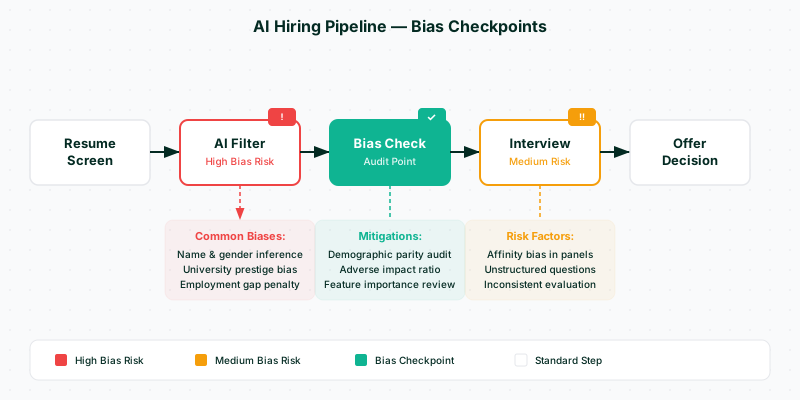
Common Sources of Bias in AI Hiring Tools
1. Resume Screening AI
How it works: AI scans resumes for keywords, education, experience patterns
Bias sources:
- School names: Overweights prestigious schools (correlates with wealth/race)
- Employment gaps: Penalizes caregivers (disproportionately women)
- Zipcode: May use address as proxy for race
- Names: Can be used to infer race, ethnicity, gender
Real example: Amazon scrapped its resume AI in 2018 after discovering it penalized resumes containing the word "women" (as in "women's chess club")
2. Video Interview AI
How it works: Analyzes facial expressions, speech patterns, word choice
Bias sources:
- Facial analysis accuracy: Lower for darker skin tones
- Speech recognition: Higher error rates for non-native speakers
- Cultural differences: Expressions of confidence vary by culture
- Disability impact: Penalizes neurodivergent communication styles
Scientific validity: None. No peer-reviewed evidence that facial expressions predict job performance.
3. "Culture Fit" AI
How it works: Compares applicants to current employees
Bias sources:
- Perpetuates homogeneity: If current workforce lacks diversity, AI replicates it
- Undefined metrics: "Culture fit" often encodes bias
- Confirmation bias: AI looks for similarities, not complementary skills
4. Assessment Game AI
How it works: Analyzes performance on game-like tasks or puzzles
Bias sources:
- Socioeconomic bias: Puzzle-solving styles vary by educational background
- Neurodiversity impact: May disadvantage ADHD, autism
- Cultural bias: Games may favor certain cognitive styles
Legal Risks for Employers
Liability Exposure
1. Disparate Impact Claims
- Plaintiffs must show AI tool has discriminatory effect on protected class
- Employer must prove tool is "job-related and consistent with business necessity"
- Employer must show no less discriminatory alternative exists
Burden of proof: Once disparate impact shown, burden shifts to employer to justify the tool
2. Disparate Treatment Claims
- AI explicitly considers protected characteristics (like iTutorGroup age cutoffs)
- Easier to prove, but less common
3. Disability Discrimination
- Failure to accommodate in AI-driven process
- AI tools that inherently disadvantage people with disabilities
4. State Law Violations
- Colorado AI Act and similar emerging state laws
- May have stricter requirements than federal law
Damages and Penalties
Compensatory Damages:
- Lost wages
- Emotional distress
- Reasonable accommodation costs
Punitive Damages (if intentional discrimination or recklessness):
- Can be substantial
- Designed to punish and deter
Attorney's Fees:
- Prevailing plaintiffs entitled to legal fees
- Can exceed damages
Injunctive Relief:
- Court orders to stop using discriminatory AI
- Required changes to hiring practices
- Ongoing monitoring
Prevention Strategies
1. Pre-Deployment Validation
Conduct bias audits before deploying AI hiring tools
- Run the tool against a representative sample of historical applicants
- Check pass-through rates across protected classes (race, gender, age, disability status)
- Validate that the tool is "job-related and consistent with business necessity" under Title VII disparate impact doctrine
- Document all validation steps; this documentation is your first line of defense in litigation
- Require vendors to provide third-party bias audit results before contract execution
The EEOC's Technical Assistance Document (2023) recommends testing on a sample of at least 1,000 applicants per protected class to achieve statistical power sufficient to detect meaningful disparate impact.
2. Ongoing Monitoring After Deployment
Bias audits are not a one-time event. AI model drift, changes in applicant demographics, and updates to the underlying model can all reintroduce bias after a clean pre-deployment validation.
Implement continuous monitoring:
- Track pass-through rates by protected class on a monthly basis
- Set an alert threshold: if pass-through rate for any protected class drops more than 10 percentage points below the majority group, trigger an immediate review
- Compare AI recommendations to final hiring outcomes: if the AI recommends diverse candidates but hiring managers override toward homogeneity, document and address the gap
- Re-audit the AI tool any time the vendor releases a model update
The Colorado AI Act (effective February 2026) explicitly requires ongoing impact assessments, not just pre-deployment validation. Get ahead of this requirement now.
3. Diverse Training Data
The most effective long-term prevention is ensuring AI hiring tools are trained on data that reflects the diversity you want to see in outcomes.
- Audit vendor training data for representation across protected classes
- Insist on transparency about the training data composition before purchasing any AI hiring tool
- Supplement vendor tools with your own validated rubrics if their training data is opaque
- Avoid tools trained exclusively on "successful" employees from historically homogeneous workforces; this is the primary mechanism by which historical bias propagates into AI decisions
4. Human Oversight and Override Capability
No AI hiring decision should be final without meaningful human review, particularly for adverse outcomes (rejections).
- Require human review for all rejections, not just approvals
- Train reviewers on how the AI tool works and what its known limitations are
- Provide a documented pathway for applicants to request human review (required under Colorado AI Act; best practice everywhere)
- Track override rates: if reviewers are overriding the AI at high rates for a particular protected class, this is evidence of bias that needs investigation
Avoid the trap of nominal human review: A human "approving" AI recommendations in under 60 seconds for every candidate is not meaningful oversight. Courts look at whether the human actually exercised independent judgment.
5. Documentation and Audit Trails
If your AI hiring process is ever challenged (by an applicant, the EEOC, a state agency, or a class action plaintiff), your documentation is your defense.
Maintain records of:
- Which AI tools were used, including vendor name and model version
- Validation results at deployment and all subsequent re-validations
- Pass-through rates by protected class, tracked monthly
- Every instance where an AI recommendation was overridden and the reason
- All complaints or reports of potential bias, and how each was investigated and resolved
- Vendor contracts, including representations made about bias testing and compliance
Retain these records for at least four years. The statute of limitations for Title VII claims is typically 300 days from the adverse action, but class actions and continuing violations can extend the look-back period significantly.
The Role of RAIL Score in Bias Prevention
RAIL Score's Fairness and Inclusivity dimensions are specifically designed to catch the patterns of bias that appear in AI hiring tools before they reach an applicant or a decision-maker.
Fairness Dimension
The RAIL Fairness dimension evaluates whether an AI-generated recommendation:
- Applies equivalent standards to comparable candidates regardless of demographic characteristics
- Avoids proxy variables that correlate with protected classes (school names, ZIP codes, certain extracurricular affiliations)
- Would have a disparate impact on any identifiable group if applied at scale
- Corrects for biased framing in the prompt rather than amplifying it
A Fairness score below 6.0 on any candidate assessment is a strong signal that the AI has made a recommendation that could expose the employer to disparate impact liability.
Inclusivity Dimension
The RAIL Inclusivity dimension evaluates whether the AI's language and reasoning:
- Uses language that is equally accessible and respectful across different backgrounds
- Avoids assumptions about "cultural fit" that encode majority-group norms
- Penalizes unconventional communication styles that may correlate with neurodiversity, non-native English, or disability
- Maintains consistent standards for candidates from different demographic groups
Implementing RAIL Score in Your Hiring Pipeline
import httpx

RAIL_API_KEY = "your_rail_api_key_here"

def evaluate_candidate_assessment(
    screening_prompt: str,
    ai_assessment: str,
    candidate_id: str
) -> dict:
    """
    Evaluate an AI-generated candidate assessment for bias before
    it reaches a hiring manager or triggers an automated rejection.
    """
    response = httpx.post(
        "https://api.responsibleailabs.ai/railscore/v1/eval",
        json={
            "prompt": screening_prompt,
            "response": ai_assessment,
            "dimensions": ["fairness", "inclusivity", "reliability", "user_impact"],
            "tier": "deep"
        },
        headers={"Authorization": f"Bearer {RAIL_API_KEY}"},
        timeout=10.0
    )
    scores = response.json()

    fairness = scores["dimensions"]["fairness"]["score"]
    inclusivity = scores["dimensions"]["inclusivity"]["score"]

    # Hiring-specific thresholds (stricter than general use)
    FAIRNESS_THRESHOLD = 7.0
    INCLUSIVITY_THRESHOLD = 6.5

    flags = []
    if fairness < FAIRNESS_THRESHOLD:
        flags.append({
            "type": "bias_risk",
            "dimension": "fairness",
            "score": fairness,
            "explanation": scores["dimensions"]["fairness"]["explanation"]
        })
    if inclusivity < INCLUSIVITY_THRESHOLD:
        flags.append({
            "type": "exclusion_risk",
            "dimension": "inclusivity",
            "score": inclusivity,
            "explanation": scores["dimensions"]["inclusivity"]["explanation"]
        })

    return {
        "candidate_id": candidate_id,
        "overall_score": scores["overall"]["rail_score"],
        "fairness_score": fairness,
        "inclusivity_score": inclusivity,
        "bias_flags": flags,
        "requires_human_review": len(flags) > 0,
        "safe_to_proceed": len(flags) == 0
    }
Threshold recommendations for hiring use cases:
| Dimension | Recommended Threshold | Action if Below |
|---|---|---|
| Fairness | 7.0 | Block automated action, require human review |
| Inclusivity | 6.5 | Flag for reviewer, document override if proceeding |
| Reliability | 7.0 | Re-generate assessment with more specific prompt |
| User Impact | 6.0 | Escalate to senior recruiter |
Legal Safe Harbor Considerations
Maintaining a documented bias prevention program does not create absolute immunity, but it substantially changes your litigation posture. Courts and the EEOC both treat documented compliance efforts as evidence of good faith.
Elements that contribute to a defensible position:
- Pre-deployment third-party bias audit (vendor-provided audits are less credible than independent ones)
- Ongoing monitoring with documented metrics and action thresholds
- Written policy requiring human review for adverse AI decisions
- Applicant-facing disclosure that AI is used in the screening process
- A process for applicants to request accommodation or human review
- Evidence that when bias was detected, corrective action was taken promptly
The EEOC's 2023 guidance on AI and employment discrimination explicitly states that employers who take these steps are in a stronger compliance position than those who rely solely on vendor assurances.
Building a Bias-Free Hiring AI Checklist
Use this checklist before deploying any AI tool in your hiring process:
Before Purchase
- Obtained and reviewed the vendor's third-party bias audit
- Confirmed training data composition is documented and representative
- Verified the tool provides a documented accommodation pathway for applicants with disabilities
- Confirmed the tool complies with Colorado AI Act (and applicable state laws) requirements
- Reviewed vendor liability terms; ensure they share responsibility for discriminatory outcomes
Before Deployment
- Conducted independent validation on a representative sample (minimum 1,000 applicants per protected class where possible)
- Confirmed pass-through rates are within 4/5ths (80%) rule tolerances across all protected classes
- Defined alert thresholds for ongoing monitoring
- Trained recruiters and hiring managers on tool limitations
- Established documentation process for all AI-assisted decisions
Ongoing
- Monthly pass-through rate review by protected class
- Quarterly bias audit of AI recommendations vs. final hiring outcomes
- Annual full re-validation, or on any model update
- Documented response to every bias flag raised by RAIL Score or monitoring system
Conclusion
The arc of AI hiring bias litigation bends clearly: from Amazon's scrapped resume tool in 2018, to the first-ever settlement with iTutorGroup in 2023, to the first class action certification against Workday in 2025, the legal framework is tightening with each passing year. The question is no longer whether AI hiring tools can produce discriminatory outcomes. Courts, researchers, and the EEOC have answered that definitively. The question is whether your organization has the documentation, monitoring, and human oversight infrastructure to demonstrate it takes that risk seriously.
RAIL Score's Fairness and Inclusivity dimensions provide the systematic, per-decision bias monitoring that legal compliance requires and that manual processes cannot sustain at scale. Every AI-generated candidate assessment can be evaluated in real time, flagged when bias signals appear, and documented in an audit trail that demonstrates ongoing compliance.
Ready to add bias detection to your AI hiring pipeline? Start evaluating your hiring AI outputs with RAIL Score today.
Legal tech AI contract analysis: 85% faster review with safety compliance
How AI-powered contract analysis achieved 85% faster review times while maintaining safety and compliance standards.
AI agent safety in 2026: the complete guide
From the OWASP Top 10 for Agentic Applications to real-world zero-click exploits, scheming behaviors, and defense frameworks -- everything you need to know about securing autonomous AI agents in 2026.