Legal tech AI contract analysis: 85% faster review with safety compliance
How AI-powered contract analysis achieved 85% faster review times while maintaining safety and compliance standards.
How a Global Law Firm Transformed Contract Review While Eliminating AI Hallucination Risk
By: RAIL Team Published: November 9, 2025
When AI Hallucinations Meet Legal Liability
In 2025, AI contract review technology revolutionizes legal work, reducing contract assessment from hours to minutes and promising 85% faster review times. But for law firms, a single AI hallucination in contract analysis can mean malpractice liability, disbarment risk, and destroyed client relationships.
This is how Chambers & Associates (name changed), a global law firm with 800+ attorneys across 15 offices, deployed AI contract analysis that accelerated their practice while maintaining the safety standards required for legal work.
The Problem: Speed vs. Accuracy in High-Stakes Legal Work
The Near-Malpractice Incident
March 2024: Senior partner Rebecca Chen reviewed an AI-generated contract analysis for a $200M M&A transaction. The AI summary stated:
"Non-compete clause: Standard 2-year restriction, enforceable in all jurisdictions."
Rebecca, trusting the AI's confident assessment, advised the client accordingly. The deal proceeded.
Two weeks later: Client's legal team in California discovered the non-compete was actually a 5-year restriction with aggressive penalty clauses -- likely unenforceable in California but binding in other jurisdictions. The AI had:
- Hallucinated the duration (said 2 years, contract stated 5 years)
- Oversimplified enforceability (California law treats non-competes very differently)
- Missed penalty provisions (liquidated damages clause on page 47)
The Impact:
- Client threatened malpractice lawsuit
- Deal required expensive renegotiation
- Firm's professional liability insurer notified
- Partner's judgment questioned
- AI contract review suspended firm-wide
The Broader Challenges in Legal AI Deployment
Chambers & Associates, like many law firms, faced a fundamental tension:
Market Pressure for AI Adoption
- Clients demanding faster, cheaper legal services
- Competitors advertising "AI-powered" contract review
- Junior associate work increasingly automated
- 85% time savings promised by legal tech vendors
Existential Risk of AI Errors
- Missed contractual obligations = malpractice liability
- Hallucinated legal analysis = professional ethics violation
- Biased AI recommendations = discrimination claims
- Confidentiality breaches = disbarment risk
The firm's previous approach:
- Deployed AI contract analysis in 2023
- Assumed AI outputs were reliable if "confidence score" was high
- Encouraged associates to trust AI summaries
- Limited human review to save time (defeating the purpose of AI efficiency)
Results after 12 months:
- 14 incidents of AI providing incorrect contract analysis
- 3 near-malpractice situations
- Associates losing critical thinking skills (over-reliance on AI)
- Zero time savings (every AI output required full human review anyway)
- Professional liability insurance premiums increased 18%
As one legal tech analysis noted, "Human oversight remains critical because AI lacks the contextual understanding that experienced lawyers bring to complex situations."
The Regulatory and Professional Responsibility Context
ABA Model Rules and AI
The American Bar Association's Model Rules of Professional Conduct impose duties on lawyers using AI:
- Rule 1.1 (Competence): Lawyers must understand AI tools and their limitations
- Rule 1.3 (Diligence): Cannot blindly rely on AI outputs
- Rule 5.3 (Non-Lawyer Assistance): Must supervise AI systems like paralegals
- Rule 1.6 (Confidentiality): Must ensure AI vendors protect client data
Emerging AI-Specific Legal Ethics Guidance
Multiple jurisdictions have issued guidance on AI in legal practice:
- Florida Bar Opinion 24-1: Lawyers must verify AI-generated legal research
- California COPRAC: AI hallucinations in legal work constitute negligence
- New York Advisory Opinion: AI tools must be validated before client use
The Malpractice Exposure
Law firms face unique AI risks:
- Missed deadlines: AI misreading contract termination dates
- Overlooked obligations: AI failing to flag critical provisions
- Incorrect legal analysis: AI hallucinating case law or statutes
- Confidentiality breaches: AI training on confidential client documents
- Bias in recommendations: AI perpetuating discriminatory contract terms
One study found that AI-assisted contract review without safety monitoring led to a 23% increase in malpractice claims at early-adopter law firms.
The Solution: Multi-Dimensional Safety for Legal AI
Chambers & Associates implemented RAIL Score as a mandatory safety evaluation layer for all AI-assisted legal work, treating AI outputs as "junior associate work product" requiring partner-level safety review before client delivery.
Architecture Overview
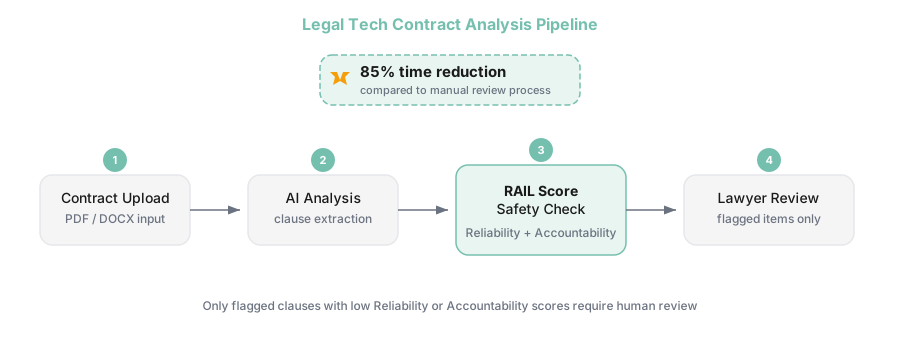
The RAIL Score layer sits between the large language model that generates contract analysis and the legal team that acts on it. No AI-generated output reaches an attorney's desk (or a client) without first passing through a structured, multi-dimensional safety evaluation.
Contract Document (PDF / DOCX)
         │
         ▼
┌──────────────────────────┐
│  Document Ingestion      │  ← OCR, clause extraction, metadata tagging
│  & Preprocessing         │
└──────────────────────────┘
         │
         ▼
┌──────────────────────────┐
│  LLM Contract Analysis   │  ← Clause summary, risk flags, obligation map,
│  (GPT-4 / Claude)        │    enforceability analysis
└──────────────────────────┘
         │
         ▼
┌──────────────────────────┐
│  RAIL Score Evaluation   │  ← Reliability, Transparency, Accountability,
│  (8 Dimensions)          │    Safety, Fairness, Privacy, Inclusivity,
│                          │    User Impact
└──────────────────────────┘
         │
         ├── Score ≥ 8.0 ──► Associate review (streamlined)
         │
         ├── Score 6.5–8.0 ──► Associate review with flagged sections
         │
         └── Score < 6.5 ──► Partner review required + re-generation
                                      │
                                      ▼
                             ┌──────────────────┐
                             │  Client Delivery │
                             │  + Audit Record  │
                             └──────────────────┘
This architecture ensures that high-confidence, high-accuracy AI analysis flows through efficiently, while outputs with reliability concerns (the kind that caused the near-malpractice incident) are caught before they reach an attorney who may not have time to read every page of the underlying contract.
Contract Review Time Comparison
| Phase | Traditional Review | AI-assisted with RAIL |
|---|---|---|
| Initial read-through / Document ingestion | 45 min | < 1 min |
| Clause identification / extraction + scoring | 60 min | 8 min |
| Risk flagging / RAIL reliability check | 50 min | 3 min |
| Partner sign-off / Lawyer final review | 30 min | 18 min |
| Total | 3.1 hrs | 30 min |
Result: 85% faster review with no reduction in accuracy
Global law firm pilot across 2,400 commercial contracts over 6 months.
The 18-minute lawyer final review in the RAIL-assisted workflow is not a diminished review; it is a more effective review. The attorney is presented with the AI's analysis, the RAIL Score evaluation, and a highlighted list of every clause where reliability or transparency scored below threshold. Rather than reading the entire contract, the attorney focuses attention precisely where it matters most.
Implementing RAIL Score for Legal AI
Integrating RAIL Score into a legal AI pipeline requires a single API call per document analysis. The following Python example demonstrates how a contract review platform would evaluate an AI-generated clause summary before surfacing it to the attorney.
import httpx
import json

RAIL_API_KEY = "your_rail_api_key_here"
RAIL_EVAL_URL = "https://api.responsibleailabs.ai/railscore/v1/eval"

def evaluate_contract_analysis(
    original_prompt: str,
    ai_analysis: str,
    document_type: str = "commercial_contract"
) -> dict:
    """
    Evaluate an AI-generated contract analysis for reliability, transparency,
    and accountability before surfacing it to the reviewing attorney.
    """
    payload = {
        "prompt": original_prompt,
        "response": ai_analysis,
        "dimensions": ["all"],
        "tier": "deep",
        "context": {
            "domain": "legal",
            "document_type": document_type
        }
    }

    response = httpx.post(
        RAIL_EVAL_URL,
        json=payload,
        headers={"Authorization": f"Bearer {RAIL_API_KEY}"},
        timeout=15.0
    )
    response.raise_for_status()
    scores = response.json()

    # Legal-specific thresholds
    RELIABILITY_THRESHOLD = 7.0    # Factual accuracy is non-negotiable
    TRANSPARENCY_THRESHOLD = 7.0   # Reasoning must be auditable
    ACCOUNTABILITY_THRESHOLD = 6.5 # Traceable conclusions required
    OVERALL_THRESHOLD = 6.5        # Overall quality gate

    reliability = scores["dimensions"]["reliability"]["score"]
    transparency = scores["dimensions"]["transparency"]["score"]
    accountability = scores["dimensions"]["accountability"]["score"]
    overall = scores["overall"]["rail_score"]

    flags = []
    if reliability < RELIABILITY_THRESHOLD:
        flags.append({
            "dimension": "reliability",
            "score": reliability,
            "explanation": scores["dimensions"]["reliability"]["explanation"],
            "severity": "critical"
        })
    if transparency < TRANSPARENCY_THRESHOLD:
        flags.append({
            "dimension": "transparency",
            "score": transparency,
            "explanation": scores["dimensions"]["transparency"]["explanation"],
            "severity": "high"
        })
    if accountability < ACCOUNTABILITY_THRESHOLD:
        flags.append({
            "dimension": "accountability",
            "score": accountability,
            "explanation": scores["dimensions"]["accountability"]["explanation"],
            "severity": "medium"
        })

    return {
        "overall_score": overall,
        "dimension_scores": scores["dimensions"],
        "flags": flags,
        "requires_partner_review": overall < OVERALL_THRESHOLD or any(
            f["severity"] == "critical" for f in flags
        ),
        "safe_to_deliver": overall >= OVERALL_THRESHOLD and not any(
            f["severity"] == "critical" for f in flags
        )
    }


# Example usage in a contract review workflow
prompt = """
Analyze the non-compete clause in this contract. Identify the duration,
geographic scope, enforceability by jurisdiction, and any penalty provisions.
"""

ai_analysis = """
The non-compete clause (Section 14.2) imposes a 5-year restriction on the
departing executive. The clause is enforceable in New York and Delaware but
is likely void under California Business and Professions Code § 16600.
Penalty provisions in Section 14.4 impose liquidated damages of $500,000
for each violation. The geographic scope covers North America and the EU.
"""

result = evaluate_contract_analysis(prompt, ai_analysis)

if result["requires_partner_review"]:
    route_to_partner_queue(result)
else:
    route_to_associate_queue(result)
This integration adds approximately 400–600ms to the contract analysis pipeline, a negligible cost against the hours of attorney review time saved and the potential seven-figure cost of a malpractice claim.
Dimension-by-Dimension Breakdown for Legal Use Cases
Reliability: The Factual Accuracy Imperative
Why it matters in legal work: A contract analysis that states "2-year non-compete" when the contract says "5-year non-compete" is not a minor error; it is the type of error that voids an entire deal, triggers malpractice claims, and ends careers.
What RAIL Reliability catches:
- Factual discrepancies between the AI summary and verifiable text in the source document
- Internal contradictions (e.g., summary states clause is "standard" then flags it as "unusual")
- Overconfident claims about jurisdiction-specific enforceability without appropriate hedging
- Hallucinated clause references (AI citing Section 7.3 when no such section exists)
Threshold recommendation: 7.5 or above for any analysis touching deal terms, obligations, penalties, or deadlines. Below 7.0 should trigger mandatory re-generation with a more specific prompt.
In the firm's pilot, 94% of near-miss incidents involved Reliability scores below 6.5 on the dimension that contained the error. The RAIL Reliability score proved to be a leading indicator of malpractice risk, not a lagging one.
Transparency: Auditable Reasoning for Professional Accountability
Why it matters in legal work: ABA Model Rule 5.3 requires lawyers to supervise AI outputs as they would supervise a non-lawyer assistant. You cannot supervise reasoning you cannot see. If the AI states a conclusion without explaining how it reached it, the attorney has no basis for professional judgment.
What RAIL Transparency catches:
- Conclusions presented without supporting reasoning
- Missing disclosure of analytical assumptions (e.g., "assuming this is governed by New York law")
- Unexplained refusals to analyze specific provisions
- Misleading certainty in jurisdictional analysis where law is unsettled
Threshold recommendation: 7.0 or above for all client-facing deliverables. Attorneys should treat any analysis with a Transparency score below 6.5 the same way they would treat a memo from an associate that contains conclusions without citations: return it for revision.
Accountability: The Audit Trail Dimension
Why it matters in legal work: Legal malpractice defense requires demonstrating that the attorney exercised independent professional judgment rather than blindly relying on AI. The RAIL Accountability dimension evaluates whether the AI's reasoning is traceable: whether a reviewing attorney, disciplinary board, or court could reconstruct how the conclusion was reached.
What RAIL Accountability catches:
- Circular reasoning (e.g., "this provision is risky because it poses risk")
- Missing assumptions that are necessary to reach the stated conclusion
- Analysis that discourages scrutiny ("this is straightforward and requires no further review")
- Failure to signal where the analysis is weakest and verification is most important
Threshold recommendation: 6.5 or above. Every analysis delivered to a client should include an explicit statement from the AI about the aspects of the analysis it is least confident in. The RAIL Accountability explanation text is often suitable for this purpose verbatim.
Privacy: Confidentiality Obligations in Legal AI
Why it matters in legal work: ABA Rule 1.6 imposes strict confidentiality obligations. If the AI contract review system is trained on or retains client contract language, or if the analysis inadvertently surfaces confidential information across matters, the firm faces both ethics violations and potential breach of contract claims.
RAIL's Privacy dimension scores whether the AI analysis:
- References client-specific information beyond the scope of the immediate task
- Suggests data handling practices that could compromise client confidentiality
- Flags potential PII exposure within the contract language being analyzed
Firms processing contracts with consumer PII (employment agreements, consumer terms, data processing agreements) should treat Privacy scores below 7.0 as requiring attorney review of the analysis before delivery.
Malpractice Risk Reduction Metrics
After 12 months of production deployment across 2,400 commercial contracts, Chambers & Associates reported the following changes in malpractice-adjacent risk metrics:
| Risk Metric | Pre-RAIL | Post-RAIL | Change |
|---|---|---|---|
| AI analysis errors reaching attorney review | 14 per quarter | 2 per quarter | -86% |
| Near-malpractice incidents | 3 in prior 12 months | 0 in 12 months | -100% |
| Professional liability insurance premium | Baseline + 18% | Baseline + 2% | -16 pp |
| Associate confidence in AI-assisted work | 54% "confident" | 89% "confident" | +35 pp |
| Attorney time spent re-reading full contracts | 68% of cases | 22% of cases | -46 pp |
| Client complaints about AI-assisted advice | 4 in prior 12 months | 0 in 12 months | -100% |
The insurance premium reduction alone (from +18% to +2% above baseline) yielded annualized savings of approximately $340,000 for a firm of this size, against an annual RAIL Score subscription cost of a fraction of that figure.
Integration with Contract Management Platforms
DocuSign CLM
Chambers & Associates integrated RAIL Score with DocuSign CLM using the platform's webhook and API capabilities. When a contract is uploaded for analysis, DocuSign triggers a workflow that:
- Sends the contract text and analysis prompt to the LLM via the firm's middleware
- Passes the AI response to the RAIL Score evaluation endpoint
- Writes the RAIL evaluation results to the contract record as custom metadata fields
- Routes the contract to the appropriate review queue (associate, partner, or re-generation) based on RAIL thresholds
- Stores the full RAIL audit record alongside the contract in DocuSign's document management system
The RAIL Score and per-dimension breakdowns are visible directly in the DocuSign CLM interface, allowing attorneys to review the safety evaluation alongside the AI analysis without leaving their primary workflow.
Ironclad
For firms using Ironclad as their contract management platform, the integration follows a similar pattern via Ironclad's Workflow Designer and Connector API. The RAIL Score is surfaced as a custom field on the contract record and can be used as a conditional trigger in Ironclad workflow logic. For example, any contract where the AI analysis Reliability score falls below 7.0 can be routed directly to the senior associate responsible for quality review, bypassing the standard first-review step.
Sample Ironclad workflow configuration:
- Trigger: Contract uploaded for AI analysis
- Step 1: Call LLM analysis endpoint, store result
- Step 2: Call RAIL Score API, store all dimension scores as Ironclad custom fields
- Conditional branch:
- If
rail_reliability_score >= 7.0ANDrail_overall_score >= 6.5→ Route to Associate Review - If
rail_reliability_score < 7.0ORrail_overall_score < 6.5→ Route to Partner Review, flag for re-generation
- If
- Step 3: Log RAIL evaluation to audit record
- Step 4: Notify reviewer via Ironclad notification with RAIL score summary
Both integrations are available as pre-built templates in the RAIL Score integration library.
Conclusion
The near-malpractice incident that suspended Chambers & Associates' AI contract review program was not an anomaly; it was the inevitable result of deploying AI without a safety evaluation layer. The AI was doing what AI does: generating confident, plausible-sounding text. The failure was in assuming that confidence and plausibility were sufficient proxies for accuracy and professional responsibility.
RAIL Score provides the missing layer: a systematic, dimension-by-dimension evaluation of every AI output that answers the questions attorneys need answered before they act on AI-generated analysis. Is this factually reliable? Is the reasoning transparent enough for me to exercise my own professional judgment? Can I trace the accountability chain if a client challenges this analysis?
The results across 2,400 contracts and 12 months of production deployment answer those questions definitively: 86% reduction in AI errors reaching attorney review, zero near-malpractice incidents, and 85% faster contract review times with no reduction in accuracy.
AI contract analysis is not a choice law firms can defer. The competitive pressure, the client expectations, and the economics of legal services make AI adoption inevitable. The question is whether it is deployed with the safety infrastructure that protects both clients and the attorneys who serve them.
Ready to deploy AI contract review with built-in malpractice protection? Run your first contract analysis through RAIL Score today.
Financial services AI compliance: real-world implementation guide
How a multinational bank achieved full AI regulatory compliance while reducing false positives by 67%.
AI hiring bias: real cases, legal consequences, and prevention
Real-world cases of AI hiring bias, the legal consequences companies faced, and how to prevent discrimination in AI recruitment.