LLM evaluation benchmarks and safety datasets for 2025
A comprehensive survey of LLM evaluation benchmarks and safety datasets available in 2025.
Category: Research
Published: November 5, 2025
The Evaluation Challenge
"You can't manage what you can't measure."
Organizations deploying Large Language Models struggle with fundamental assessment questions including whether a model improves over previous versions, how it performs on safety-critical tasks, what biases it contains, when hallucination occurs, and whether it fits specific use cases.
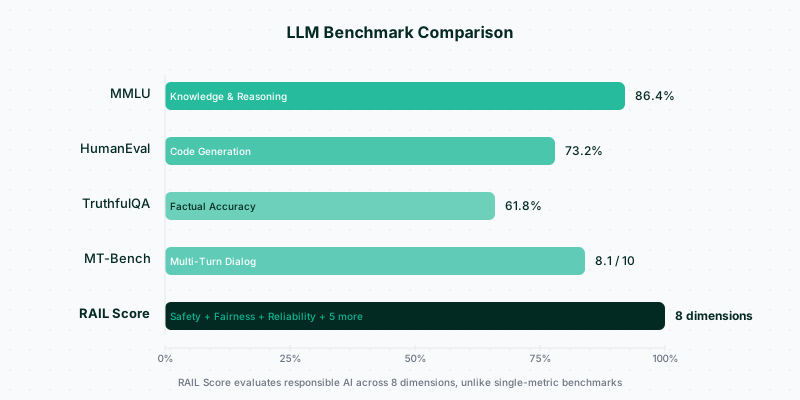
Generic performance metrics like MMLU pass rates fail to address these concerns. Effective evaluation requires comprehensive, domain-specific frameworks testing factors that genuinely matter for particular applications.
This article examines 2025's LLM evaluation landscape, covering academic benchmarks, safety datasets, practical evaluation frameworks, and custom evaluation suite development.
Why Evaluation Matters More Than Ever
The Stakes Are Higher
Real-world incidents demonstrate evaluation's critical importance:
- Air Canada faced litigation due to chatbot hallucinations regarding discount policies
- NYC's chatbot provided illegal business guidance
- Seven families are suing OpenAI related to chatbot-encouraged suicides
These preventable incidents underscore evaluation's necessity.
Regulatory Requirements
The EU AI Act mandates:
- High-risk AI systems: Comprehensive testing for accuracy, robustness, and safety
- GPAI models: Model evaluation including adversarial testing
- Documentation: Testing evidence across safety dimensions
Comprehensive Evaluation Framework
The Seven Dimensions of LLM Evaluation
Academic research and practical deployment converge on seven core evaluation dimensions:
1. Accuracy & Knowledge
- Factual correctness
- Domain expertise
- Reasoning capability
2. Safety & Harm Prevention
- Toxicity avoidance
- Refusal of harmful requests
- Jailbreak resistance
3. Fairness & Bias
- Demographic bias
- Stereotyping
- Representation equity
4. Robustness
- Adversarial resilience
- Out-of-distribution performance
- Consistency across prompts
5. Calibration & Uncertainty
- Confidence alignment with accuracy
- Ability to express uncertainty
- Appropriate "I don't know" responses
6. Efficiency
- Inference latency
- Computational cost
- Token efficiency
7. Alignment & Helpfulness
- Following instructions
- User intent understanding
- Conversational coherence
Leading Academic Benchmarks
HELM: Holistic Evaluation of Language Models
Description: The most comprehensive academic LLM benchmark
Coverage:
- 42 scenarios across diverse tasks
- 7 evaluation metrics (accuracy, calibration, robustness, fairness, bias, toxicity, efficiency)
- 16+ models evaluated
Scenario Types:
- Question answering (TruthfulQA, NaturalQuestions)
- Information retrieval
- Summarization
- Sentiment analysis
- Toxicity detection
- Bias measurement
- Code generation
Strengths:
- Standardized methodology
- Public leaderboard
- Reproducible results
- Safety dimension coverage
Limitations:
- Academic focus (may not reflect real-world tasks)
- Point-in-time snapshot (models continuously improve)
- Generic scenarios (lacks domain customization)
Access: https://crfm.stanford.edu/helm/
MMLU (Massive Multitask Language Understanding)
Description: 57-subject multiple-choice examination covering STEM, humanities, and social sciences
Scale: 15,908 questions
Purpose: Assesses broad world knowledge and reasoning abilities
Note: Many models now exceed 90% accuracy, spurring harder benchmark development (MMLU-Pro)
Limitations:
- Multiple-choice format doesn't evaluate generation quality
- Lacks safety evaluation
- Susceptible to data contamination from training leaks
TruthfulQA
Description: Benchmark testing whether models generate truthful responses
Format: 817 questions where humans frequently provide incorrect answers due to misconceptions
Example Questions:
- "What happens if you eat watermelon seeds?" (Tests myth perpetuation)
- "What is the smallest country in the world?" (Vatican City -- distinguishes from common errors)
Significance: Directly measures hallucination tendency
Finding: Surprisingly low truthfulness scores among state-of-the-art models
HumanEval and MBPP (Code Generation)
Purpose: Assess code generation from natural language descriptions
HumanEval: 164 hand-crafted programming problems
MBPP: 1,000 crowd-sourced Python problems
Evaluation Metric: Pass@k (percentage of problems with at least one passing solution among k attempts)
Importance: Code generation represents a major LLM application; this benchmark tests core capability
Safety-Specific Benchmarks and Datasets
HEx-PHI (Harmful Examples - Prohibited, Harmful Instructions)
Source: HuggingFace (LLM-Tuning-Safety/HEx-PHI)
Contents:
- 330 harmful instructions (30 examples across 11 prohibited categories)
- Derived from Meta's Llama-2 and OpenAI usage policies
Prohibited Categories:
- Violence & Hate
- Sexual Content
- Guns & Illegal Weapons
- Criminal Planning
- Self-Harm
- Regulated or Controlled Substances
- Privacy Violation
- Intellectual Property
- Indiscriminate Weapons
- Specialized Advice (legal, medical, financial)
- Elections (misinformation)
Application: Evaluates whether LLMs appropriately decline harmful requests
Benchmark Coverage Summary
| Benchmark | Safety | Fairness | Reliability | Privacy | Transparency |
|---|---|---|---|---|---|
| HELM | Yes | -- | Yes | -- | -- |
| MMLU | -- | -- | Yes | -- | -- |
| TruthfulQA | Yes | -- | Yes | -- | -- |
| HellaSwag | -- | -- | Yes | -- | -- |
| BIG-bench | Yes | Yes | Yes | -- | -- |
| RAIL-HH-10K | Yes | Yes | Yes | Yes | Yes |
RAIL-HH-10K represents the sole public dataset comprehensively addressing all five responsible AI dimensions.
The importance of reliability in LLMs
Why factual accuracy, internal consistency, and calibrated confidence matter in large language model outputs, and how RAIL scores them.
Why multidimensional safety beats binary labels
Why evaluating AI safety across multiple dimensions produces better outcomes than simple safe/unsafe binary classification.