Why multidimensional safety beats binary labels
Why evaluating AI safety across multiple dimensions produces better outcomes than simple safe/unsafe binary classification.
Understanding RAIL Score
By: RAIL Research Team Published: November 1, 2025
The Limitations of Binary Safety Classifications
For years, AI safety evaluation has relied on binary classifications: content is either "safe" or "harmful." This oversimplified approach has served as a starting point, but as AI systems become more sophisticated and deployed in critical applications, this black-and-white paradigm reveals serious limitations.
Consider a customer service chatbot that occasionally makes stereotypical assumptions about users based on their names. Is this system "safe" or "harmful"? The answer isn't binary -- it depends on context, severity, frequency, and the specific dimension of harm being considered.
The Rise of Multidimensional Safety Frameworks
Modern AI safety evaluation frameworks recognize that safety is not a single metric but a multidimensional space. Research from institutions like the Future of Life Institute and frameworks like NIST's AI Risk Management Framework have embraced this nuanced approach.
The 8 Dimensions of RAIL Score
RAIL Score evaluates AI systems across 8 independent dimensions, each scored 0-10 with a confidence level of 0-1:
1. Fairness (0-10, confidence 0-1)
- Assesses whether the AI's outputs are equitable and free from harmful bias
- Evaluates demographic bias across protected classes
- Measures representation equity and outcome fairness
2. Safety (0-10, confidence 0-1)
- Measures the AI's ability to avoid causing harm and to function securely
- Evaluates toxicity, hate speech, and dangerous content
- Assesses context-appropriate vs. genuinely harmful content
3. Reliability (0-10, confidence 0-1)
- Evaluates the AI's consistency and dependability in performance
- Measures output stability across similar inputs
- Assesses error handling and graceful degradation
4. Transparency (0-10, confidence 0-1)
- Considers how understandable the AI's decision-making process is
- Evaluates model decision interpretability
- Measures audit trail availability and explainability
5. Privacy (0-10, confidence 0-1)
- Examines how the AI handles and protects user data
- Assesses personal information leakage risks
- Evaluates compliance with data protection regulations (GDPR, CCPA)
6. Accountability (0-10, confidence 0-1)
- Looks at who is responsible for the AI's actions and outcomes
- Evaluates governance structures and oversight mechanisms
- Measures incident response capabilities
7. Inclusivity (0-10, confidence 0-1)
- Assesses if the AI serves a diverse range of users and needs
- Evaluates accessibility across different user groups
- Measures cultural sensitivity and representation
8. User Impact (0-10, confidence 0-1)
- Measures the overall effect the AI has on its users
- Evaluates both positive and negative outcomes
- Assesses long-term impact on user well-being
The RAIL Score Approach
At Responsible AI Labs, the RAIL Score functions as a weighted sum of these 8 dimensions. Unlike binary classifiers, RAIL Score provides:
- Overall RAIL Score: A float value between 0-10 representing weighted safety
- RAIL Confidence: A float value between 0-1 indicating assessment certainty
- Dimension-specific scores: Each of the 8 dimensions scored 0-10 with confidence 0-1
- Contextual evaluation that considers use case and deployment environment
- Actionable insights that help developers understand exactly where improvements are needed
- Continuous monitoring that tracks safety metrics over time
Real-World Impact
Consider a financial services company deploying an AI advisor. A binary "safe/unsafe" label provides almost no actionable information. RAIL Score's multidimensional safety profile might reveal:
- Overall RAIL Score: 7.8/10 (confidence: 0.92)
- Safety: 9.5/10 (confidence: 0.95) - Excellent toxicity prevention
- Privacy: 9.2/10 (confidence: 0.88) - Strong data protection
- Fairness: 6.7/10 (confidence: 0.91) - Needs improvement, showing demographic bias in loan recommendations
- Reliability: 8.9/10 (confidence: 0.87) - Consistent performance
- Transparency: 7.1/10 (confidence: 0.79) - Moderate explainability, could be clearer
- Accountability: 8.5/10 (confidence: 0.85) - Good governance structures
- Inclusivity: 8.2/10 (confidence: 0.83) - Serves diverse user base well
- User Impact: 8.4/10 (confidence: 0.90) - Positive overall user outcomes
This granular feedback enables targeted improvements. The team knows to focus on Fairness (demographic bias) and Transparency (explainability), rather than wasting resources on already-strong dimensions like Safety and Privacy.
The Science Behind Multidimensional Evaluation
Recent research has validated the multidimensional approach:
Pattern-Based Scoring
Early safety classifiers used simple pattern matching -- looking for keywords or phrases associated with harm. While fast, these methods produce high false positive rates and miss contextual nuances.
Fine-Tuning-Based Scoring
Modern approaches employ specialized models fine-tuned on curated safety datasets. Models like LlamaGuard3, ShieldLM, and RAIL's proprietary scorers achieve significantly higher precision by learning nuanced patterns of different harm types.
Prompt-Based Evaluation
Large language models themselves can be used as safety judges when prompted with carefully designed evaluation criteria. This approach captures semantic understanding but requires robust prompt engineering and validation.
Hybrid Approaches
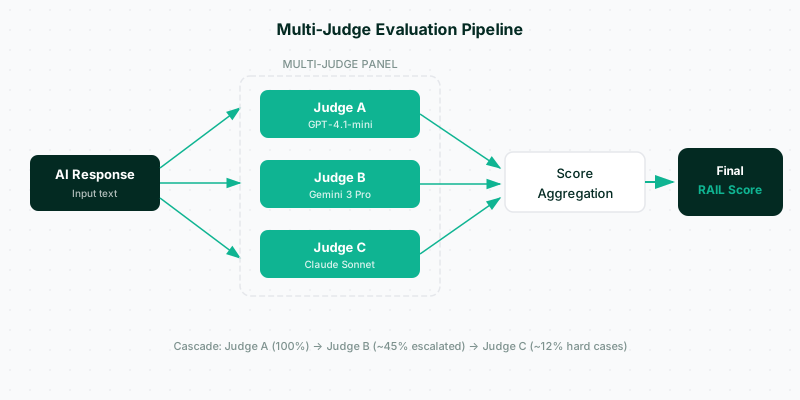
State-of-the-art systems, including RAIL Score, combine multiple scoring methodologies to achieve both accuracy and comprehensive coverage across safety dimensions.
Implementing Multidimensional Safety
Organizations adopting multidimensional safety evaluation typically follow this progression:
Phase 1: Baseline Assessment
- Evaluate current AI systems across all safety dimensions
- Identify critical gaps and priorities
- Establish acceptable thresholds for each dimension
Phase 2: Targeted Remediation
- Address high-priority safety gaps
- Implement dimension-specific improvements
- Validate improvements through continuous testing
Phase 3: Ongoing Monitoring
- Deploy continuous safety monitoring
- Track trends and emerging risks
- Iterate based on real-world performance
Phase 4: Governance Integration
- Embed safety scores in deployment pipelines
- Create safety-conditional releases
- Build organizational safety culture
The Future of AI Safety Evaluation
As we move into 2025 and beyond, several trends are reshaping AI safety evaluation:
Regulatory Alignment: The EU AI Act and similar regulations explicitly require multidimensional risk assessment. Binary classifications simply don't meet regulatory requirements for high-risk AI applications.
Domain-Specific Metrics: Healthcare AI needs different safety dimensions than financial AI or creative AI. Expect increasingly specialized evaluation frameworks.
Real-Time Adaptation: Safety evaluation is moving from pre-deployment testing to continuous runtime monitoring with dynamic thresholds.
Explainable Safety Scores: Users and regulators demand to understand not just that a system is safe, but why and how we know it's safe.
Conclusion
The shift from binary to multidimensional safety evaluation represents maturation of the AI safety field. While binary labels offered simplicity, they sacrificed the nuance necessary for real-world deployment of AI systems in critical applications.
RAIL Score's 8-dimensional framework provides:
- Granular Assessment: Each dimension scored 0-10 with confidence 0-1
- Weighted Overall Score: RAIL Score (0-10) and RAIL Confidence (0-1)
- Accuracy: More precise identification of specific safety concerns across all 8 dimensions
- Actionability: Clear guidance on where improvements are needed
- Compliance: Alignment with evolving regulatory requirements (EU AI Act, NIST AI RMF)
- Trust: Transparent, explainable safety assessments
The 8 dimensions -- Fairness, Safety, Reliability, Transparency, Privacy, Accountability, Inclusivity, and User Impact -- work together to provide a comprehensive view of AI system safety.
As AI systems become more powerful and more integrated into critical infrastructure, the question is no longer whether to adopt multidimensional safety evaluation, but how quickly we can implement it.
Ready to implement multidimensional safety evaluation? Get started with RAIL Score or explore the documentation to learn more about the 8-dimensional approach to comprehensive AI safety.
For research details, see the paper: RAIL in the Wild: Operationalizing Responsible AI Evaluation and the dataset: RAIL-HH-10K on Hugging Face.
LLM evaluation benchmarks and safety datasets for 2025
A comprehensive survey of LLM evaluation benchmarks and safety datasets available in 2025.
Beyond text: bias and safety challenges in multimodal AI
How bias manifests differently in multimodal AI systems that process text, images, and audio together.