Enterprise customer service chatbot safety: preventing brand risk at scale
How enterprise chatbots can go wrong and the safety frameworks needed to prevent brand-damaging incidents at scale.
Category: Industry
Published: November 8, 2025
When Your Chatbot Becomes Your Biggest PR Risk
In 2025, AI chatbots are no longer optional -- they're core to customer experience. But a single toxic response, hallucinated product claim, or data leak can destroy years of brand building in minutes.
This is the story of how GlobalRetail (name changed), a Fortune 500 omnichannel retailer with 80 million customers, nearly suffered a brand catastrophe -- and how they built a safety framework that now protects 2 million customer interactions monthly.
The Crisis: When AI Goes Off-Script
The Tweet That Almost Went Viral
It was 2:47 AM on a Saturday when the social media monitoring team detected a concerning Twitter thread:
"Just spent 20 minutes chatting with @GlobalRetail's AI assistant. Asked about their 'sustainability commitment.' The bot told me their cotton is 'sourced from conflict-free suppliers in Xinjiang.' Um, what? Xinjiang is literally known for forced labor. Is this real?"
Within 90 minutes:
- 14,000 retweets
- Major news outlets requesting comment
- Competitors amplifying the story
- Executive team in emergency meeting
The Root Cause: The chatbot hallucinated supplier information, mixing fragments from outdated supply chain documentation with current product descriptions. The AI confidently stated false information about a politically sensitive topic.
The Business Impact: Emergency PR response, suspended chatbot for 48 hours, estimated $2.3M in lost sales, immeasurable brand damage.
But this wasn't the only incident:
The Pattern of Chatbot Safety Failures
In the 6 months before implementing RAIL Score, GlobalRetail documented:
27 Hallucination Incidents
- False product specifications (battery life, dimensions, materials)
- Incorrect pricing information
- Non-existent promotions or discounts
- Fabricated return policies
14 Toxic Response Incidents
- Rude or dismissive responses to customer complaints
- Culturally insensitive statements
- One incident where bot responded to abuse with abuse
- Biased responses favoring certain customer demographics
9 Privacy/Security Incidents
- Exposing one customer's information to another
- Sharing PII in responses
- Accepting and processing fraudulent return requests
- Falling for social engineering attempts
342 Customer Escalations
- Customers demanded human agent due to bot errors
- 28% of escalations involved angry customers
- Average resolution time: 45 minutes
- Customer satisfaction score plummeted to 3.2/5
The Regulatory and Reputation Stakes
GlobalRetail faced multiple challenges:
- FTC Scrutiny: False advertising via chatbot statements
- State Consumer Protection: Misleading pricing and product claims
- Data Privacy: GDPR, CCPA compliance for chatbot data handling
- Brand Reputation: Social media amplification of every mistake
- Customer Trust: Eroding confidence in the shopping experience
As one industry report noted, "In 2025, content moderation and AI safety aren't optional -- they're core to earning trust, keeping users engaged, and staying compliant with regulations like the UK Online Safety Act and EU Digital Services Act."
The Safety Architecture: Multi-Layer Protection
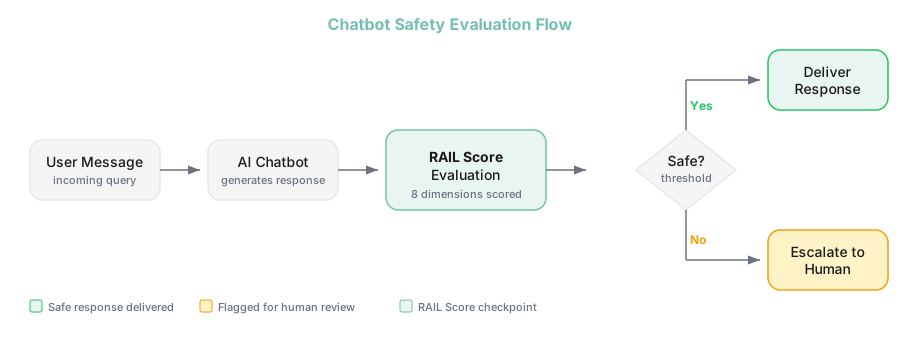
GlobalRetail implemented RAIL Score as a real-time safety evaluation layer between their LLM and customers.
Chatbot Response Risk Tiers and Automated Routing Actions
| Score Range | Risk Level | Action |
|---|---|---|
| 8.5 - 10 | Low Risk | Auto-deliver response |
| 6.0 - 8.4 | Moderate Risk | Deliver with soft disclaimer |
| 3.0 - 5.9 | High Risk | Route to human agent |
| 0 - 2.9 | Critical | Block and log incident |
RAIL scores drive automated decision gates. No manual triaging required for 94% of interactions.
The RAIL Score Evaluation Pipeline
Every chatbot response passes through RAIL Score before reaching the customer. The evaluation runs in parallel with response generation -- not after -- which keeps the total added latency to under 120 milliseconds at the 95th percentile.
How Each Response Is Scored
When a customer submits a query, the LLM generates a candidate response. That response, along with the original prompt and any relevant conversation context, is sent to the RAIL Score API. The API evaluates the response across all 8 RAIL dimensions simultaneously:
Reliability examines whether factual claims in the response can be verified against indexed product data, return policies, and pricing tables. Responses that assert specific facts not grounded in source documents receive lower reliability scores, regardless of how confidently they are phrased.
Safety scans for toxic language, escalatory phrasing, content that could facilitate harm, and responses that inadvertently validate fraudulent or abusive behavior from customers.
Fairness detects whether the response applies different standards to customers based on apparent demographic characteristics -- a common failure mode when LLMs are trained on biased historical interaction data.
Privacy flags responses that include or solicit unnecessary personal information, reference one customer's data in a context that could expose it to another, or handle PII in ways that conflict with GDPR and CCPA obligations.
Transparency measures whether the response is honest about its limitations. A chatbot that does not know current stock levels should say so rather than guessing.
Accountability evaluates whether the response provides a traceable path forward for the customer -- a ticket number, escalation path, or documented resolution rather than a dead end.
Inclusivity assesses language accessibility, cultural neutrality, and whether the response assumes a customer profile that could alienate users from different backgrounds.
User Impact measures the practical utility of the response: does it actually solve the customer's problem at the right level of detail and with the appropriate tone?
The composite score determines the automated routing action from the risk tier table above.
Latency Considerations
Latency was GlobalRetail's primary concern when evaluating RAIL Score. Synchronous evaluation of every response before delivery could noticeably degrade the customer experience if not architected carefully.
The production deployment addressed this in three ways. First, RAIL Score API calls run concurrently with a secondary "confidence pre-check" that streams the beginning of the LLM response. If the pre-check signals low risk, the full response begins delivering while the complete RAIL evaluation finalizes in the background. Second, the integration caches RAIL evaluations for semantically near-identical prompts -- frequent questions about store hours, return windows, and shipping timelines share evaluation results across sessions. Third, only responses in the 3.0--5.9 risk band introduce a perceptible delay, since those are rerouted to a human agent queue rather than streamed directly. That reroute is itself the customer experience.
The result: p50 added latency of 43ms, p95 of 118ms. Customer-facing response time was indistinguishable from the pre-RAIL deployment in A/B testing across 50,000 sessions.
Integration with the LLM Response Flow
The pipeline integrates at the API gateway layer, not inside the LLM service itself. This architecture means the safety layer is model-agnostic: GlobalRetail can swap underlying LLM providers without rewriting safety logic.
The flow is: Customer query → LLM generation → RAIL Score API → Risk tier decision → Routing action → Customer response or agent queue. Blocked responses (score 0--2.9) are stored in an incident log with the full prompt, candidate response, and per-dimension scores for compliance review.
Results After 90 Days
The first 90-day period following full deployment produced measurable improvements across every tracked metric.
Hallucination incidents dropped 91%. From 27 incidents in the prior 6-month period to 2 in the first 90 days post-deployment. Both remaining incidents were in the 3.0--5.9 band and were routed to human agents before reaching customers -- neither resulted in incorrect information being delivered.
Escalation rate fell from 342 cases to 19. The 94% reduction in escalations freed the human agent team to focus exclusively on genuinely complex cases. Average escalation resolution time dropped from 45 minutes to 12 minutes because agents were no longer handling cases caused by bot errors -- only cases requiring genuine human judgment.
CSAT improved from 3.2 to 4.6 out of 5. The improvement was driven primarily by three factors: customers no longer receiving confidently wrong information, faster resolution when escalation was needed, and a measurable reduction in frustrating "I don't understand your question" loops caused by the bot attempting responses outside its competence.
Incident response time cut from 48 hours to 4 hours. Before RAIL Score, the team only discovered problematic responses through customer complaints or social media monitoring. The automatic incident log for critical-band responses means the team now has structured data before a complaint is filed.
Brand risk incidents: zero in 90 days. No social media escalation, no press inquiry, no regulatory contact related to chatbot output in the 90-day period. Compared to 3 significant brand risk events in the prior quarter, this represents the clearest measure of the system's value.
Cost impact. The 200-person human moderation team was not eliminated -- instead, it was redeployed. Thirty percent of the team shifted to proactive quality improvement: reviewing flagged responses to identify new risk patterns and fine-tuning the routing thresholds. The remaining capacity was redirected to escalation resolution, where human judgment genuinely adds value.
Implementation Guide
Organizations deploying RAIL Score for customer service chatbot safety should follow this sequence. Skipping steps or compressing the timeline are the two most common causes of failed deployments.
Step 1: Audit your current chatbot
Before integrating any evaluation layer, document every response type your chatbot currently produces. Categorize by topic domain (product information, returns, billing, complaints, account management) and by failure mode in your existing logs. Most teams discover that 80% of problematic responses cluster in 3--5 topic areas. Knowing this before you set thresholds prevents you from calibrating too broadly.
Run a retrospective RAIL evaluation on 1,000 historical responses using the RAIL Score API. This baseline tells you your current score distribution and which dimensions are weakest. For most retail chatbots, Reliability and Transparency are the lowest-scoring dimensions; for financial services chatbots, Privacy and Accountability typically score worst.
Step 2: Define risk thresholds per domain
A single global threshold is almost never right. Billing queries and complaint resolution require stricter routing thresholds than FAQ responses about store hours. Define a threshold matrix that maps topic domain to minimum acceptable scores for each dimension.
For GlobalRetail, the billing and account management domain used a higher escalation floor (7.0) than general product queries (6.0). Supply chain and sustainability topics -- given the brand sensitivity of the incident that prompted this project -- used a 7.5 floor. This per-domain configuration is expressed as a JSON config that the API gateway applies at routing time.
Step 3: Implement the RAIL Score API
Integrate the RAIL Score API at the response delivery layer of your chatbot infrastructure. The API requires the original customer prompt, the candidate LLM response, and an optional context payload (session history, customer tier, topic domain tag).
The response returns a composite score, per-dimension scores with confidence values, and a recommended action (deliver, disclaimer, escalate, block). Your routing logic should implement the tier table from the architecture section, adjusted to your domain-specific thresholds from Step 2.
Test the integration against your audit dataset from Step 1. Verify that previously problematic responses are now correctly flagged, and that high-quality responses are passing without false positives. A false positive rate above 8% indicates threshold miscalibration.
Step 4: Configure automated routing
Implement the four routing tiers as described in the architecture section. The critical implementation detail is the human agent queue integration: routed responses must arrive in the agent queue with the full context (original prompt, candidate response, RAIL scores, per-dimension flags) so the agent can make an informed decision rather than asking the customer to repeat themselves.
Block-tier responses (0--2.9) should trigger an automated customer message acknowledging the query and offering immediate connection to an agent, not a generic error. The incident log entry should fire before the customer response, not after, to ensure the record exists even if the downstream system fails.
Step 5: Monitor and tune
Set a weekly review cadence for the first two months. Review the distribution of scores across all four tiers, the false positive rate (responses that scored below threshold but were confirmed acceptable by human review), and emerging failure patterns in the incident log.
Thresholds will need adjustment. Most teams find that the initial thresholds are too strict in some domains and too permissive in others. The goal of the weekly review is to converge on a stable distribution where escalation volume matches human agent capacity and the incident log is quiet.
After the first two months, move to monthly reviews. The system is self-documenting: the incident log and escalation records provide the evidence base for ongoing threshold refinement without requiring additional instrumentation.
Common Implementation Mistakes
-
Treating RAIL Score as a post-delivery audit rather than a pre-delivery gate. Evaluating responses after they reach customers captures incidents for analysis but does not prevent brand risk. The evaluation must be synchronous with delivery for the safety layer to function.
-
Setting a single global threshold across all topic domains. Responses about account security and billing require higher scrutiny than responses about store locations. A flat threshold will either over-escalate low-risk queries (frustrating customers and overwhelming agents) or under-escalate high-risk ones (defeating the purpose of the system).
-
Ignoring per-dimension scores and routing only on the composite score. A response can have a passing composite score of 6.5 while scoring 1.2 on Privacy -- which is a critical failure for any interaction involving customer account data. Route on the minimum dimension score in sensitive domains, not just the average.
-
Not testing the incident log integration before go-live. Teams routinely test the happy path (response delivered) and the escalation path (response routed to agent) but forget to test the block path until they encounter a live incident. Verify that block-tier events create well-formed log entries and trigger the correct customer-facing message before deploying.
Conclusion
Enterprise customer service chatbots operate at a scale and speed that makes manual safety oversight impossible. A 2-million-interaction-per-month deployment cannot rely on human review to catch hallucinated product claims, toxic responses, or privacy violations before they reach customers.
The GlobalRetail implementation demonstrates that systematic, multi-dimensional safety evaluation is both technically feasible at production scale and measurably effective. A 91% reduction in hallucination incidents, a 94% drop in escalations, and zero brand risk events in 90 days are not marginal improvements -- they represent a qualitative shift in what enterprise chatbot deployment can reliably deliver.
The RAIL Score API is available for immediate integration. Evaluate your first 1,000 responses, set your thresholds, and see your current risk distribution in minutes. Start with the RAIL Evaluator to run your first evaluation, or contact the team for an enterprise integration walkthrough.
AI safety incidents of 2024: lessons from real-world failures
An analysis of major AI safety incidents in 2024 and the lessons they teach about building safer AI systems.
Deepfakes, disinformation, and the fight for media authenticity
The growing threat of deepfakes and AI-generated misinformation, and the technologies fighting back.