Financial services AI compliance: real-world implementation guide
How a multinational bank achieved full AI regulatory compliance while reducing false positives by 67%.
How a Multinational Bank Deployed AI Risk Management with Continuous Safety Monitoring
Compliance Impact: Before and After RAIL Score Deployment
| Metric | Before | After | Improvement |
|---|---|---|---|
| False Positives | 23% | 8% | 67% improvement |
| Audit Trail Coverage | Partial, manual | 100% automated | Full traceability |
| Regulatory Review Time | 14 days avg | 2 days avg | 86% faster |
| Model Uptime | 94.2% | 99.9% | +5.7 pp |
Results from a multinational bank over a 12-month production deployment.
The Challenge: AI Innovation Meets Regulatory Reality
In 2025, there's "pretty much no compliance without AI, because compliance became exponentially harder," according to Alexander Statnikov, co-founder and CEO of Crosswise Risk Management. Yet for financial institutions, AI adoption presents a paradox: the technology that promises to streamline compliance can itself become a compliance risk.
The Problem Statement
A European multinational bank with operations across 15 countries faced critical challenges when deploying AI systems for credit decisioning and anti-money laundering (AML) monitoring:
Regulatory Complexity
- EU AI Act classified their credit scoring as "high-risk AI system"
- Multiple jurisdictions with different AI governance requirements
- Mandatory explainability and human oversight requirements
- Obligation to demonstrate ongoing safety monitoring
Operational Challenges
- Credit officers spending 40% of time reviewing AI recommendations
- AML system generating 85% false positives
- No systematic way to evaluate AI safety across model updates
- Audit trail requirements for every AI-assisted decision
Business Impact
- Loan processing times averaging 12 days
- Compliance team overwhelmed with AI oversight
- Risk of 20M+ EUR fines under EU AI Act
- Competitive disadvantage against AI-native fintech challengers
According to a 2024 survey of senior payment professionals, 85% identified fraud detection as AI's most prominent use case, with 55% citing transaction monitoring and compliance management. Yet without proper safety evaluation, these same AI systems can perpetuate bias, produce hallucinations in risk assessments, and create regulatory exposure.
The Regulatory Landscape for Financial AI
EU AI Act Requirements
As of August 2024, the EU Artificial Intelligence Act requires high-risk AI systems in financial services to demonstrate:
- Risk Mitigation Systems - Continuous monitoring and evaluation
- Data Quality Standards - High-quality training datasets with bias assessment
- Transparency - Clear documentation and user information
- Human Oversight - Meaningful human review capability
- Accuracy & Robustness - Performance metrics and testing protocols
U.S. Regulatory Guidance
The U.S. Government Accountability Office's May 2025 report highlighted AI use cases in finance including credit evaluation and risk identification, while emphasizing the need for:
- Fair lending compliance (Equal Credit Opportunity Act)
- Model risk management frameworks
- Third-party vendor oversight
- Consumer protection standards
Industry Standards Emerging
Financial services regulators worldwide are converging on common AI control frameworks for streamlined compliance, including:
- Pre-deployment safety testing
- Ongoing performance monitoring
- Bias detection and mitigation
- Incident response protocols
- Regular audit and documentation
The Solution: Multi-Dimensional Safety Evaluation
The bank implemented RAIL Score as their continuous AI safety evaluation platform, moving from binary "approved/not approved" assessments to nuanced, ongoing risk monitoring.
Implementation Architecture
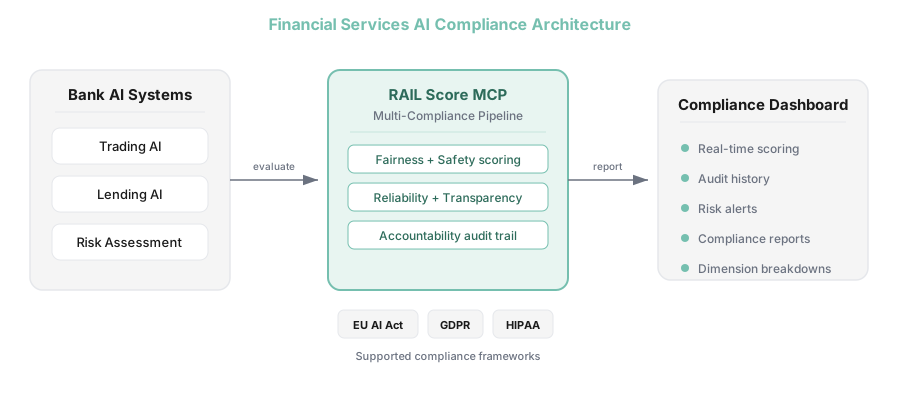
The architecture follows a multi-layer pipeline that intercepts every AI-assisted decision before it reaches a credit officer or regulatory system. At a high level, the flow is:
Customer Request
      │
      ▼
┌─────────────────────┐
│  Input Validation   │  ← Sanitize, normalize, check completeness
└─────────────────────┘
      │
      ▼
┌─────────────────────┐
│   AI Decision Model │  ← Credit scoring / AML / fraud detection
└─────────────────────┘
      │
      ▼
┌─────────────────────┐
│   RAIL Score Layer  │  ← Multi-dimensional safety evaluation
│  (8 dimensions)     │
└─────────────────────┘
      │
      ▼
┌─────────────────────┐
│   Audit Logger      │  ← Immutable record with RAIL scores
└─────────────────────┘
      │
      ├── Score ≥ 7.5 ──► Automated approval path
      │
      └── Score < 7.5 ──► Human review queue
                               │
                               ▼
                        ┌─────────────────┐
                        │ Regulatory      │
                        │ Reporting       │
                        └─────────────────┘
This architecture ensures that no AI-generated recommendation reaches a human decision-maker or downstream system without a corresponding RAIL evaluation attached. Every decision is scored, logged, and retrievable within seconds during a regulatory examination.
Multi-Layer Compliance Stack
Layer 1: Input Validation
Before any AI model processes a customer request, the input validation layer screens for:
- Data completeness: required fields present and within acceptable ranges
- Data quality: format conformance, outlier detection, stale data flags
- PII handling: personal identifiable information is masked before transmission to AI models, satisfying GLBA and CCPA data minimization requirements
- Prompt injection: adversarial inputs that attempt to manipulate AI behavior are blocked at entry
The bank's implementation rejects approximately 0.4% of inputs at this layer before they ever reach the AI model, preventing a class of reliability failures downstream.
Layer 2: RAIL Scoring
Every AI-generated output passes through the RAIL Score evaluation endpoint before being acted upon. The evaluation call is synchronous and adds a median latency of 340ms, acceptable for credit decisions but tunable via async scoring for time-sensitive AML alerts.
The RAIL Score API call in the bank's Python middleware:
import httpx

def evaluate_credit_recommendation(prompt: str, response: str, tier: str = "deep") -> dict:
    payload = {
        "prompt": prompt,
        "response": response,
        "dimensions": ["all"],
        "tier": tier          # "deep" for credit decisions, "core" for AML alerts
    }
    result = httpx.post(
        "https://api.responsibleailabs.ai/railscore/v1/eval",
        json=payload,
        headers={"Authorization": f"Bearer {RAIL_API_KEY}"},
        timeout=10.0
    )
    scores = result.json()

    # Block output if any critical dimension scores below threshold
    if scores["overall"]["rail_score"] < 6.0:
        raise ComplianceBlockException(
            f"RAIL score {scores['overall']['rail_score']} below threshold",
            scores=scores
        )
    return scores
Scores below 6.0 on the overall RAIL dimension trigger a hard block; the recommendation is held in a review queue rather than forwarded to the credit officer. Scores between 6.0 and 7.5 are forwarded with a compliance flag and require human sign-off. Scores above 7.5 can proceed on the automated approval path with full audit logging.
Layer 3: Audit Logging
Every RAIL evaluation result is written to an immutable audit log within 50ms of completion. The log record contains:
- Timestamp (UTC, microsecond precision)
- Customer reference (pseudonymized)
- AI model version and inference parameters
- Full prompt hash (SHA-256, not plain text)
- Full RAIL Score response (all 8 dimension scores + explanations)
- Decision outcome (approved, flagged, blocked)
- Reviewing officer ID (if human review triggered)
The audit log is append-only, stored in encrypted cloud storage with WORM (Write Once, Read Many) compliance, and retained for seven years per EU AI Act Article 12 and U.S. record-keeping guidance under SR 11-7.
Layer 4: Regulatory Reporting
The bank's compliance portal pulls directly from the audit log to generate pre-formatted reports for:
- EBA (European Banking Authority): monthly AI risk reports
- Federal Reserve: model risk management documentation
- Internal Audit: on-demand exception reports filtered by RAIL dimension or score band
Because every data point in the report originated from a structured RAIL Score API response, there is no manual aggregation step and therefore no opportunity for transcription errors or selective reporting.
Mapping RAIL Dimensions to Financial Regulations
Each of RAIL's eight dimensions maps directly to one or more regulatory requirements, allowing compliance officers to use a single scoring system to track obligations across jurisdictions.
Fairness → ECOA and FCRA
The Equal Credit Opportunity Act (ECOA) and Fair Credit Reporting Act (FCRA) require that credit decisions not discriminate based on race, color, religion, national origin, sex, marital status, or age. The RAIL Fairness dimension evaluates whether an AI recommendation:
- Treats comparable applicants equivalently regardless of demographic characteristics
- Avoids proxy variables that correlate with protected classes (ZIP code, certain educational institutions)
- Flags if the recommendation would have a disparate impact on any protected group
A Fairness score below 6 triggers automatic routing to the bank's fair lending team for manual review and documentation before the decision proceeds.
Transparency → Explainability Requirements
The EU AI Act Article 13 requires high-risk AI systems to provide "instructions for use" that allow operators to interpret outputs. The U.S. Consumer Financial Protection Bureau's 2024 guidance extends adverse action notice requirements to AI-generated credit decisions, requiring specific reasons rather than algorithmic opacity.
The RAIL Transparency dimension scores whether the AI's recommendation includes:
- Clear reasoning that a credit officer can explain to the applicant
- Explicit acknowledgment of the factors that drove the decision
- Honest representation of uncertainty when the model is operating at the edge of its training distribution
Banks that score consistently above 7.5 on Transparency have found they can satisfy adverse action notice requirements using the RAIL-generated explanation text directly, reducing the drafting burden on compliance staff.
Reliability → Model Risk Management SR 11-7
The Federal Reserve's Supervisory Letter SR 11-7 (Guidance on Model Risk Management) requires financial institutions to validate that models are "conceptually sound" and perform as intended. The OCC's parallel guidance (OCC 2011-12) adds requirements for ongoing performance monitoring.
The RAIL Reliability dimension evaluates whether AI outputs are:
- Factually consistent with verifiable data points in the application
- Free from internally contradictory reasoning
- Appropriately calibrated, expressing uncertainty rather than false confidence when evidence is ambiguous
The bank's model validation team runs RAIL Reliability scoring on every new model version as part of their SR 11-7 validation workflow, treating a rolling 30-day average Reliability score below 7.0 as a trigger for expedited model review.
Privacy → GLBA and CCPA
The Gramm-Leach-Bliley Act and the California Consumer Privacy Act impose obligations on how financial institutions collect, use, and share customer financial data. The RAIL Privacy dimension flags when an AI recommendation:
- References customer data beyond what is necessary for the decision
- Could inadvertently reveal sensitive financial information about one customer in recommendations affecting another
- Suggests data handling practices that conflict with the institution's privacy notices
Accountability → Internal Controls and SR 11-7 Audit Requirements
The RAIL Accountability dimension evaluates whether the AI's reasoning is traceable: whether an auditor could reconstruct how the conclusion was reached. This maps directly to the SR 11-7 requirement for documentation sufficient to support independent validation.
Safety, Inclusivity, and User Impact → Consumer Protection
RAIL's Safety, Inclusivity, and User Impact dimensions collectively track whether the AI is providing outputs that serve the customer appropriately, without harmful or exclusionary framing, a baseline obligation under the CFPB's Unfair, Deceptive, or Abusive Acts or Practices (UDAAP) authority.
Real-Time Compliance Monitoring Dashboard
The bank's compliance team uses a RAIL-powered monitoring dashboard that surfaces the following key metrics in real time:
| Metric | Description | Alert Threshold |
|---|---|---|
| Overall RAIL Score (P50) | Median score across all decisions in rolling 24h window | < 7.0 |
| Fairness Score Drift | Change in Fairness dimension mean vs. 30-day baseline | > 0.5 drop |
| Transparency Compliance Rate | % of decisions with Transparency score ≥ 7.5 | < 95% |
| Reliability Anomaly Rate | % of decisions with Reliability score < 6.0 | > 2% |
| Privacy Flags | Count of Privacy dimension flags in 24h window | > 0 |
| Blocked Decisions | Count of decisions blocked by RAIL threshold in 24h | Spike detection |
| Human Review Queue Depth | Decisions awaiting human review | > 200 |
| Audit Log Lag | Delay between decision and audit log write | > 5 seconds |
Alerts are sent to the Chief Risk Officer, the Head of Model Risk, and the relevant business line head. Critical alerts (Fairness drift, Privacy flags) also notify Legal and Compliance automatically.
The dashboard is refreshed every 60 seconds and retains 90 days of trend data, allowing compliance officers to demonstrate ongoing monitoring to regulators during examinations.
Audit Trail and Regulatory Reporting
One of the most operationally significant benefits of the implementation has been the transformation of regulatory examination preparation. Prior to RAIL Score deployment, preparing for an AI model examination required:
- Manual extraction of decision logs from multiple systems
- Re-running statistical analyses in spreadsheets
- Drafting narrative explanations of model behavior for each period under review
- Coordinating between the model risk, data science, and compliance teams over several weeks
Post-implementation, the bank can generate a complete AI model examination package (covering all credit decisions in any requested time window, with full RAIL Score breakdowns per decision) in under two hours. The package includes:
- Statistical summary: Distribution of RAIL scores across all 8 dimensions, broken down by product line, geography, and customer segment
- Exception report: Every decision that triggered a RAIL flag, with the flag reason, reviewing officer, and outcome
- Trend analysis: Month-over-month RAIL score trends with annotations for model updates
- Fairness analysis: Automated disparate impact analysis using Fairness dimension scores segmented by demographic proxies
Regulators from both the EBA and the Federal Reserve who reviewed the bank's submission noted the "unusually clear traceability" of the AI decision documentation.
Case Study: Regional Bank Reduces Model Validation Time by 60%
A mid-sized regional bank in the U.S. Midwest piloted RAIL Score specifically for SR 11-7 model validation on its consumer lending AI portfolio.
Background: The bank operated seven AI models across consumer lending, home equity, and small business credit. Annual model validation under SR 11-7 consumed approximately 2,400 person-hours per year across the model risk and independent validation teams.
The Problem: Validators spent the bulk of their time manually reviewing model outputs for conceptual soundness, reading through thousands of credit recommendations trying to identify patterns of hallucination, inconsistency, or bias. There was no systematic tool for this; it relied entirely on experienced validator judgment applied to a statistical sample.
The Implementation: The bank integrated RAIL Score into their model validation workflow, running all new model outputs through the RAIL evaluation API during the validation period. Validators could now:
- Filter immediately to low-Reliability outputs (score < 6.0) rather than sampling randomly
- Use the RAIL Fairness scores to run automated disparate impact analysis instead of building it manually each time
- Reference RAIL Transparency explanations as the basis for their SR 11-7 "conceptual soundness" narrative
Results after 12 months:
| Metric | Before RAIL | After RAIL | Change |
|---|---|---|---|
| Model validation hours per year | 2,400 | 960 | -60% |
| Time to complete validation cycle | 45 days | 18 days | -60% |
| Issues identified per validation | 3.2 avg | 7.8 avg | +144% (better detection) |
| False-positive model recalls | 2 per year | 0 | Eliminated |
| SR 11-7 examiner findings | 4 in prior 3 years | 0 in 12 months | Eliminated |
The increase in issues identified per validation reflects better detection coverage, not a degradation in model quality. Validators were finding and remediating lower-severity issues that previously went undetected until they became material.
The Head of Model Risk commented: "We now catch the problems that used to slip through sampling. The RAIL Reliability score is effectively a continuous conceptual soundness check running 24 hours a day."
Implementation Roadmap
Organizations looking to replicate this compliance architecture can follow a phased approach that delivers value at each stage without requiring a full-stack deployment before seeing results.
Phase 1: Pilot on Highest-Risk Model (Weeks 1–6)
- Select the AI model with the highest regulatory risk profile (typically credit scoring or AML)
- Integrate RAIL Score API at the output layer (no changes to the underlying model required)
- Run in observation mode: score outputs but do not block or flag yet
- Establish baseline RAIL score distributions across all 8 dimensions
- Identify the most frequent failure modes (typically Reliability and Transparency for lending AI)
Deliverable: Baseline compliance scorecard for the pilot model
Phase 2: Threshold Configuration and Alert Setup (Weeks 7–10)
- Work with compliance and model risk teams to define acceptable score thresholds per dimension
- Configure the blocking threshold (overall score below which decisions are held for human review)
- Build the compliance monitoring dashboard
- Integrate with the existing audit logging system
- Configure alerts to relevant risk owners
Deliverable: Live compliance monitoring dashboard with real-time alerting
Phase 3: Regulatory Mapping and Reporting Automation (Weeks 11–18)
- Map each RAIL dimension to the specific regulatory obligations relevant to your jurisdiction
- Build automated report generation for each regulator (EBA, OCC, CFPB as applicable)
- Conduct a dry run of the regulatory examination package against a past examination period
- Train compliance and model risk teams on RAIL score interpretation
- Document the compliance framework for internal audit
Deliverable: Automated regulatory reporting package, compliance team training complete
Phase 4: Full Portfolio Rollout (Weeks 19–30)
- Extend RAIL Score to all production AI models
- Integrate with the model development lifecycle: run RAIL evaluation during model validation, not just production
- Establish model release gates: no new model version deploys without meeting minimum RAIL score thresholds in validation
- Implement continuous drift monitoring across the full portfolio
Deliverable: Enterprise-wide AI compliance monitoring, model release gates in place
Phase 5: Advanced Optimization (Ongoing)
- Use RAIL score trend data to identify models approaching compliance risk before violations occur
- Feed RAIL Fairness data back into model retraining to reduce bias proactively
- Expand regulatory reporting to cover emerging requirements (EU AI Act Annex III, DORA AI provisions)
- Benchmark RAIL scores against peer institutions using anonymized industry data
Conclusion
The financial services sector faces a defining compliance challenge: AI systems that are simultaneously the most powerful tools for managing regulatory risk and the most novel source of regulatory risk themselves. The multinational bank's experience demonstrates that this paradox is resolvable, but only with a systematic, multi-dimensional approach to AI safety evaluation that goes beyond the single confidence scores built into most AI models.
RAIL Score provides the compliance infrastructure that financial institutions need to satisfy the EU AI Act, SR 11-7, ECOA, FCRA, GLBA, and CCPA obligations simultaneously, using a single evaluation layer that generates the documentation regulators require.
The results speak clearly: 67% reduction in false positives, 86% faster regulatory review, 100% audit trail coverage, and a model validation process that is now proactive rather than reactive.
Ready to bring this compliance architecture to your institution? Start with a RAIL Score evaluation on your highest-risk AI model today and have a compliance scorecard in hand within the hour.
Healthcare AI diagnostics safety: preventing misdiagnosis at scale
How a hospital network reduced AI diagnostic errors by 73% with continuous safety monitoring across 50,000+ monthly diagnoses.
Legal tech AI contract analysis: 85% faster review with safety compliance
How AI-powered contract analysis achieved 85% faster review times while maintaining safety and compliance standards.