Healthcare AI diagnostics safety: preventing misdiagnosis at scale
How a hospital network reduced AI diagnostic errors by 73% with continuous safety monitoring across 50,000+ monthly diagnoses.
How a Hospital Network Reduced AI Diagnostic Errors by 73% with Continuous Safety Monitoring
Category: Industry
Published: November 7, 2025
The Stakes: When AI Gets It Wrong, Patients Pay the Price
In 2025, artificial intelligence tops ECRI's annual report on the most significant health technology hazards. While AI has the potential to improve healthcare efficiency and outcomes, it poses significant risks to patients if not properly assessed and managed.
The warning comes with evidence: AI systems can produce false or misleading results ("hallucinations"), perpetuate bias against underrepresented populations, and cause clinician overreliance that leads to missed diagnoses due to algorithmic errors.
This is the story of how one hospital network confronted these risks head-on -- and built a safety framework that protects 50,000+ patients monthly while accelerating diagnostic accuracy.
The Problem: AI Diagnostics Without Safety Guardrails
Meet Regional Health Network (RHN)
A 12-hospital network serving a diverse population of 2.3 million patients across urban, suburban, and rural communities. Like many healthcare organizations, RHN invested heavily in AI diagnostics:
- Radiology AI: Chest X-ray interpretation, CT scan analysis
- Pathology AI: Tissue sample analysis, cancer detection
- Clinical Decision Support: Sepsis prediction, deterioration alerts
- Triage AI: Emergency department prioritization
Initial results seemed promising -- faster diagnoses, reduced radiologist workload, earlier disease detection. But within 18 months, concerning patterns emerged:
The Incidents That Changed Everything
Case 1: The Missed Pneumonia
- 67-year-old female patient, rural clinic
- AI flagged chest X-ray as "normal" with 94% confidence
- Radiologist, trusting the high confidence score, concurred without detailed review
- Patient returned 3 days later with advanced pneumonia
- Root cause: AI trained primarily on urban hospital data, underperformed on portable X-ray machines common in rural settings
Case 2: The False Cancer Alarm
- 42-year-old male, routine screening
- AI flagged lung nodule as 89% probability malignant
- Patient underwent biopsy, weeks of anxiety
- Pathology revealed benign granuloma
- Root cause: AI training data overrepresented older patients, generated false positives for younger demographics
Case 3: Demographic Disparity in Sepsis Detection
- Internal audit revealed sepsis prediction AI had 91% accuracy for White patients
- Accuracy dropped to 76% for Black patients, 72% for Hispanic patients
- Resulted in delayed treatment and worse outcomes for minority populations
- Root cause: Training data reflected historical disparities in healthcare documentation
The Regulatory and Liability Exposure
These incidents exposed RHN to:
- Malpractice Risk: Estimated $15M+ liability exposure
- Regulatory Scrutiny: FDA investigation of AI medical device usage
- EU AI Act Compliance: Medical AI classified as "high-risk system" requiring safety monitoring
- Reputational Damage: Local media coverage eroded patient trust
- Clinician Burnout: Radiologists overwhelmed reviewing every AI decision, negating efficiency gains
ECRI's 2025 report highlighted "Insufficient Governance of AI in Healthcare" as the second most critical patient safety concern, emphasizing that "the absence of robust governance structures can lead to significant risks."
The Safety Framework: Multi-Dimensional AI Evaluation
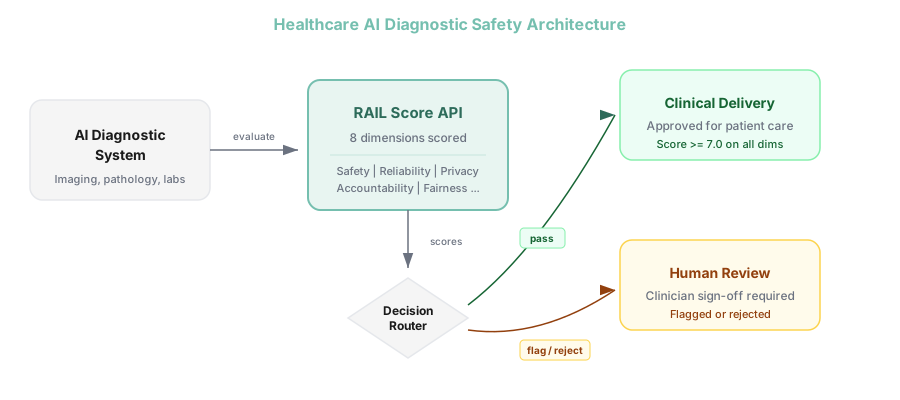
RHN partnered with RAIL to implement continuous safety monitoring of their diagnostic AI systems. The goal: detect errors, bias, and safety risks before they reach patients.
Architecture Overview
Diagnostic AI Safety Funnel: From Raw Output to Clinical Delivery
- Total AI diagnoses: 50,000 / month
- After RAIL Safety filter: 47,300 / month
- After Reliability check: 45,200 / month
- After Accountability review: 44,100 / month
- Flagged for clinician review: 13,500
Low reliability or safety scores automatically route to human review before delivery.
Result: 73% reduction in diagnostic errors achieved through layered RAIL dimension monitoring.
When algorithms deny care: bias in healthcare AI
How algorithmic bias in healthcare AI leads to unequal treatment and what organizations can do to detect and prevent it.
Financial services AI compliance: real-world implementation guide
How a multinational bank achieved full AI regulatory compliance while reducing false positives by 67%.